Most "email marketing ideas" lists read like someone dumped 50 campaign types into a blender and hit publish. A little abandoned cart here, a birthday email there, a giveaway for good measure. No logic. No sequence. No sense of when each idea actually earns its place in your calendar.
This one's different.
Every idea in this playbook is organized around what you're actually trying to make your customer do at each stage of the lifecycle: awareness, consideration, conversion, and retention. That framing matters because the right email at the wrong stage is just noise.
You'll find 30+ email marketing ideas below, each with a real brand example from 2024 to 2026. No hypotheticals. No "imagine if you…" hand-waving. Just campaigns that shipped, with a breakdown of why they worked and how you can adapt the pattern.
For context, we're writing this through the lens of ecommerce email marketing, which is what we build Drip to power. But most of these ideas translate to any business that sells online.
Table of Contents
- How to Pick the Right Email Idea (the 5-Question Filter)
- Part 1: Awareness Stage — Get on Their Radar
- Part 2: Consideration Stage — Move Them Closer
- Part 3: Conversion Stage — Close the Sale
- Part 4: Retention Stage — Keep Them Coming Back
- Seasonal & Holiday Email Marketing Ideas
How to Pick the Right Email Marketing Idea (the 5-Question Filter)
Before you build anything, run your email campaign idea through five questions. They take 60 seconds and save you from sending the wrong email to the wrong person at the wrong time.
1. Who is this for? Not "my list." A specific segment, a specific lifecycle stage. An email for first-time visitors looks nothing like an email for repeat buyers.
2. Where are they in the journey? Awareness, consideration, conversion, or retention? This determines tone, offer, and urgency level. A hard sell to someone who just subscribed yesterday feels pushy. A soft nudge to someone with three abandoned carts feels weak.
3. What's the one action I want them to take? Click to shop. Reply with feedback. Complete their profile. One email, one job. If you're asking for two things, you're getting neither.
4. What proof or value am I leading with? A discount isn't proof. Social proof, education, or a free resource earns the click. The discount closes it.
5. How does this fit into the broader sequence? Every email exists in a flow, not in isolation. A welcome email's job changes depending on what email 2 and email 3 are doing. Think in sequences, not in sends.
Run every idea below through this filter, and you'll build campaigns that actually fit your customer's reality.
Part 1: Awareness Stage — Get on Their Radar
Awareness emails introduce the brand, build familiarity, and deliver early value. They're not selling. They're earning the right to send the next email. If you skip this stage and jump straight to promotion, you'll get unsubscribes instead of customers.
1. Welcome Email
When to use it: First send after signup. The strongest welcomes aren't a single email. They're a sequence that earns the right to sell.
Welcome emails have the highest open rate of any email type. The temptation is to cash in immediately with a discount. But the better play is to spend the first emails on brand, product, and proof, then offer the discount once the subscriber actually understands what they're buying into.
The discount lands harder because attention has already been invested.
Refillable deodorant brand Fussy runs a five-email welcome sequence over roughly ten days. It's a textbook case for sequencing over single sends.
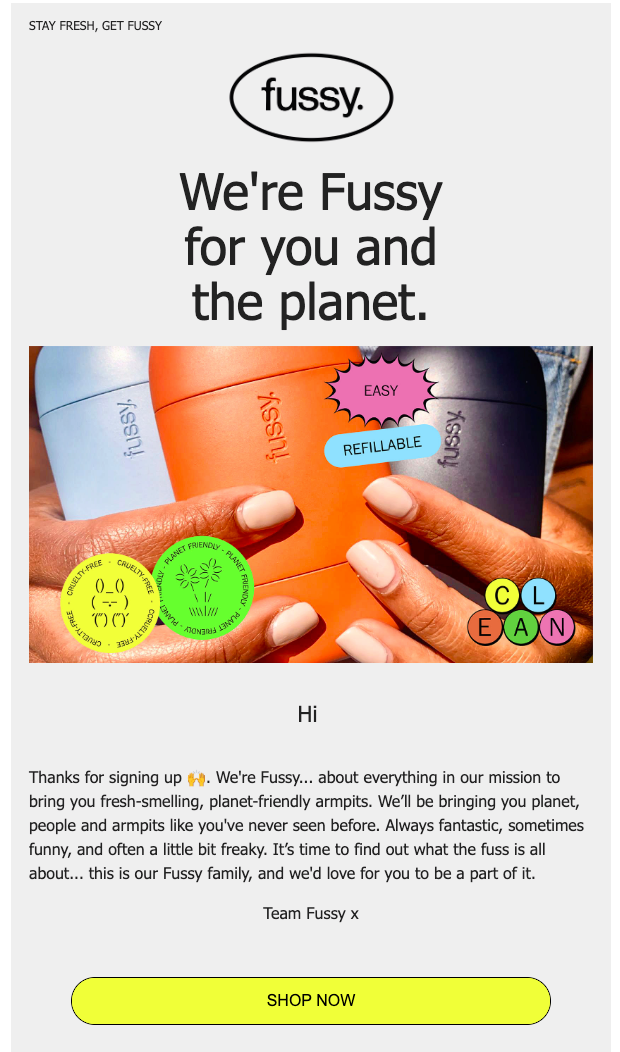
- Email 1, "Welcome to Fussy 💪🌍," is pure brand intro. Who they are, what "Fussy" means, an invitation to join the family. No product pitch.
- Email 2, "How To Smell Like A Hero ♻️," covers the product mechanic: the "Drop, Twist, Go" three-step refill, plus a list of frustrations Fussy avoids ("no trips to the refill store, no underarm pit creams, no cardboard tubes you can't get wet").
- Email 3 tells the design story. Pebble-shaped container, recycled plastic, sugarcane refills that compost in the bin.
- Email 4 delivers sustainability proof: an 81% CO2 reduction over 12 months versus standard deodorant, validated through a life-cycle analysis with Climate Partner.
Then email 5 arrives: "Look 10% Off Just For You 👀."
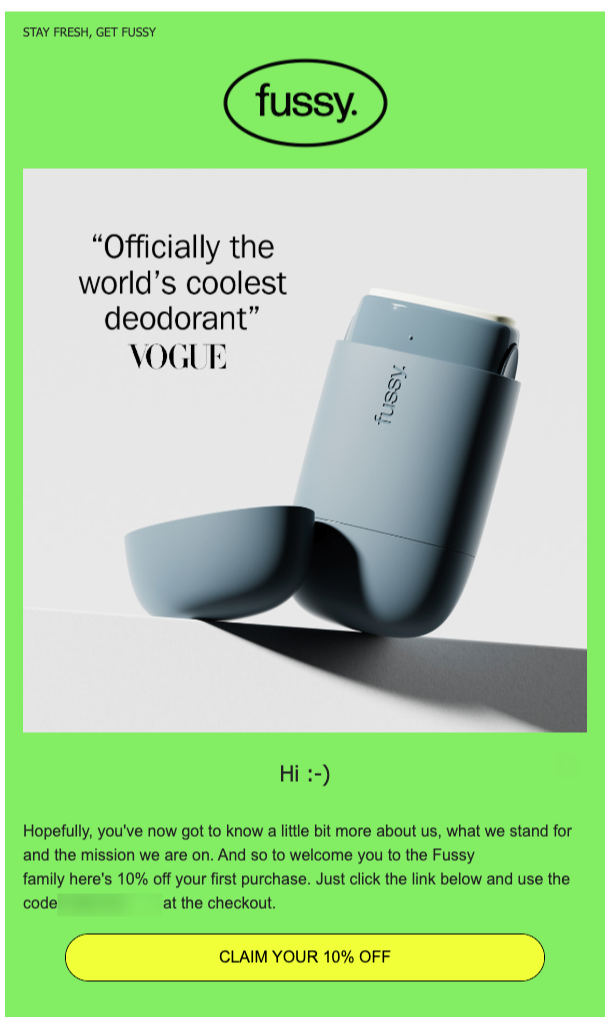
By the time the discount arrives, the subscriber has absorbed the brand mission, the product mechanic, the design rationale, and the environmental proof. The 10% feels like a reward for paying attention rather than the reason to pay attention.
That distinction is what separates a welcome series from a glorified coupon. If you're using a tool like Drip, you can build this as a visual workflow with time delays between each email and a goal node that pulls the subscriber out of the sequence the moment they purchase.
2. Email Newsletter
When to use it: Recurring (weekly or biweekly) engagement with subscribers who aren't actively buying.
The strongest brand newsletters don't just sell products.
They help the reader get more out of products they've already bought. That reframes the email from "buy more" to "do more with what you have," which raises the perceived value of every past purchase and earns the open.
Makesy supplies the DIY maker community with fragrance oils, candle wax, and soap molds. Their customers are hobbyists and small-business makers actively producing their own product lines.
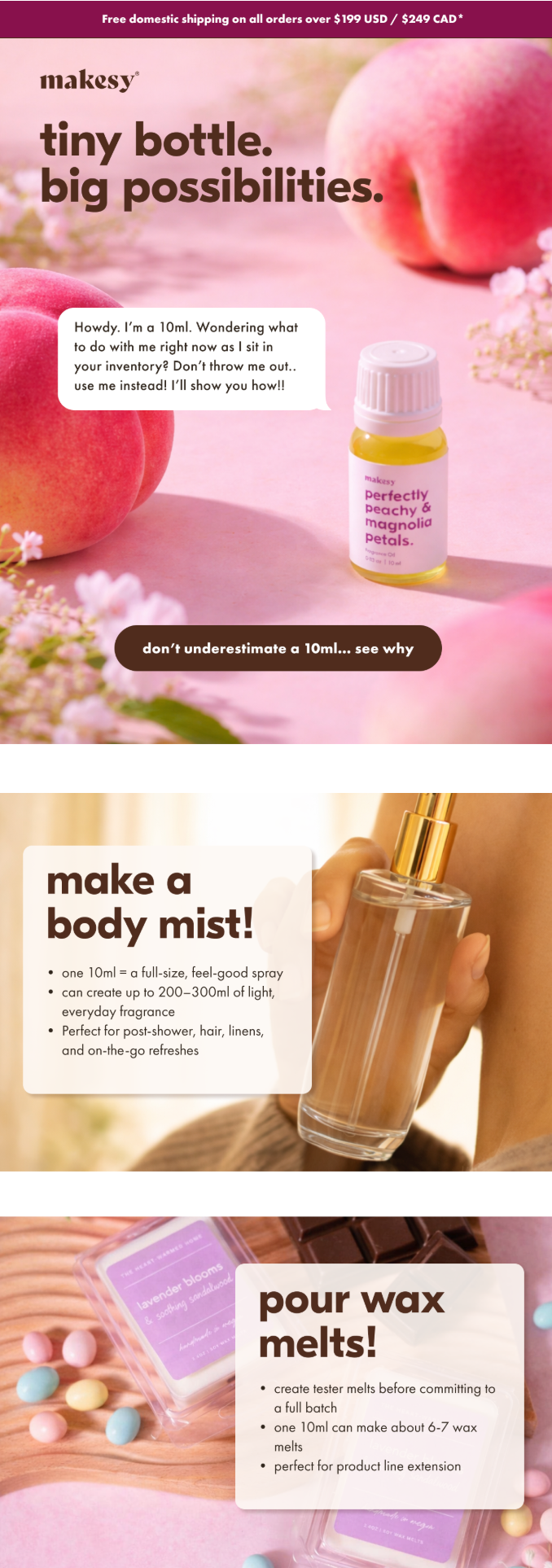 This newsletter tackles a real, unspoken pain point: the leftover 10ml fragrance bottles piling up unused in maker inventory.
Three things to copy here. First, it addresses a problem the customer didn't realize they had. Makers accumulate small bottles. Makesy reframes "leftover inventory you forgot about" as "raw material for new products," which actively increases the perceived value of past purchases instead of pushing new ones.
Second, the use cases are specific and quantified. Not "use it for body mist" but "one 10ml = 200–300ml." Numbers turn vague ideas into things makers can plan around.
Third, the hero personifies the product. A talking bottle earns attention in the inbox preview and introduces the premise without a wall of text.
Worth noting: this works for Makesy because their brand voice supports it. If it would clash with yours, copy the underlying move (speak to a real customer pain point in the hero) instead.
3. Reminder / Profile Completion Email
When to use it: When a subscriber has taken an early action (signed up, claimed a discount, started onboarding) but hasn't used what's sitting in their account.
A good reminder removes the reason someone stopped. That usually means restating the value, lowering perceived effort, and adding a real (not manufactured) deadline.
Vacation is a DTC sunscreen brand with a deliberate retro-luxury voice. This email goes to subscribers who got a 10% welcome discount and haven't used it yet.
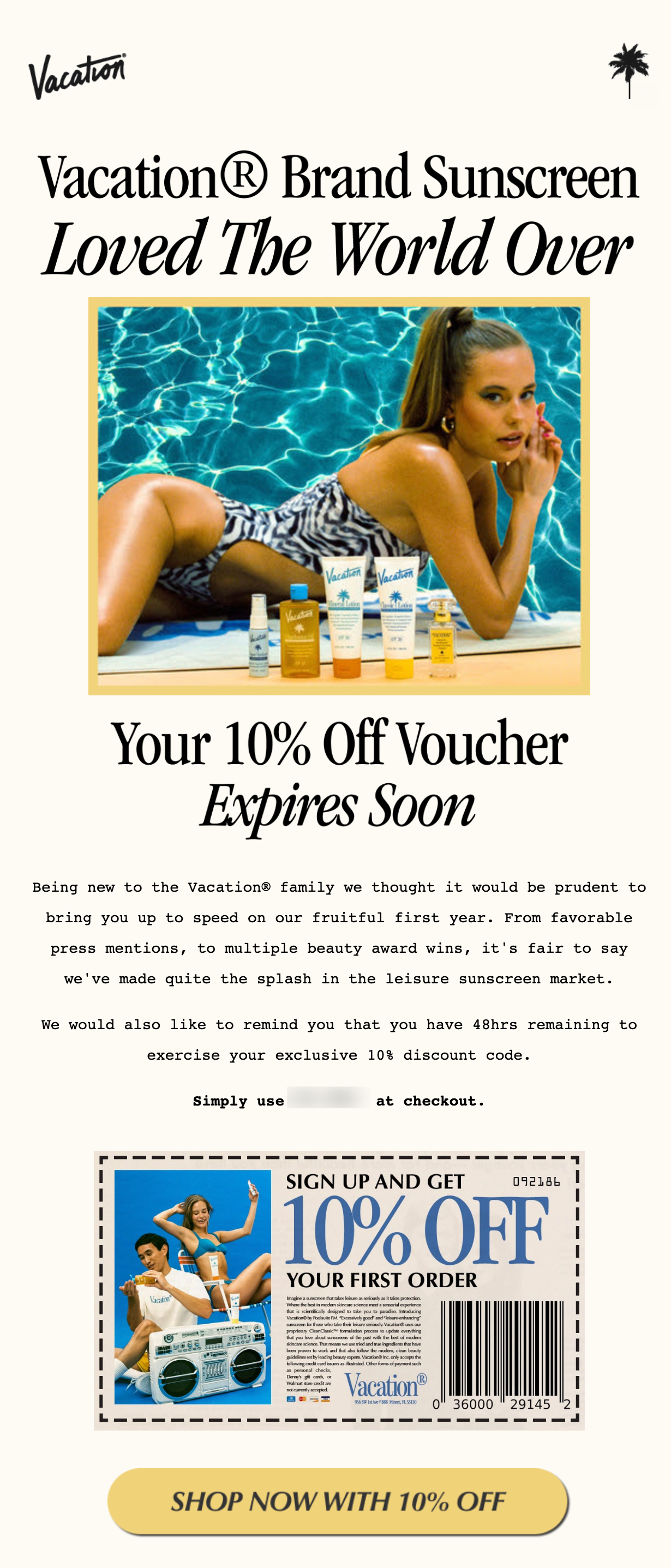 A few things to copy here. The deadline is specific and short ("48hrs remaining," not "limited time").
The word "remind" appears in the copy, which is more honest than pretending this isn't a follow-up. The press logos directly answer the hesitation that caused the inaction, because a subscriber who didn't use a discount usually stalled on trust, not interest. And the product grid removes the next friction: a reminder that says "use your discount" without showing what to buy puts the work back on the subscriber.
One brand-specific note: "prudent to bring you up to speed on our fruitful first year" is consciously over-formal. That's the voice doing work a generic "hey friend" reminder couldn't. Don't copy the words. Copy the principle that a reminder email is also a brand impression.
4. Social Proof Email
When to use it: When the subscriber knows you exist but hasn't bought, and the thing keeping them from buying is doubt about whether the product actually works.
The strongest social proof emails don't just stack reviews. They pick reviews that answer the specific objection your buyer hasn't said out loud. For high-trust categories (oral care, supplements, skincare, baby), the unspoken question is "is this safe and effective?" Generic five-star testimonials don't answer that.
Bite makes plastic-free toothpaste tabs. The unspoken objection for any prospective oral care buyer is "will my dentist think this is fine?" This entire email is engineered around that single question.
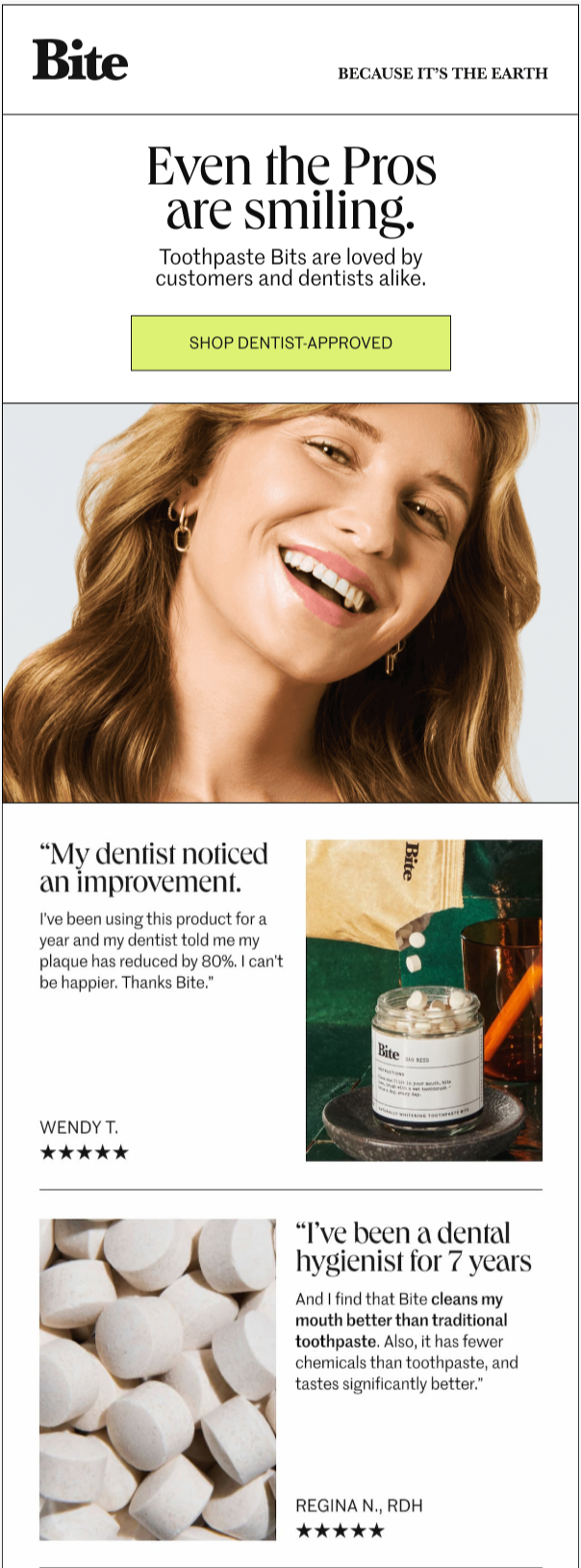
Two things to copy. First, customer testimonials containing expert validation beat expert testimonials. Bite isn't quoting dentists directly. They're quoting customers whose dentists validated the product. Customer voice is relatable. Expert authority is credible. One quote does both jobs, and it sidesteps the "is this a paid endorsement?" suspicion.
Second, one review has a specific number. "Plaque has reduced by 80%" is the killer detail. Specific outcomes plus specific timeframes plus specific authority combine to make a single review do the work of ten generic five-star ratings.
The pattern to adapt: identify the single biggest unspoken objection your buyer has, then source customer reviews that answer that specific objection through verifiable outcomes. Generic reviews are noise. Objection-answering reviews are conversion.
5. Curated Product Email
When to use it: When you want to introduce products without leading with a hard sell.
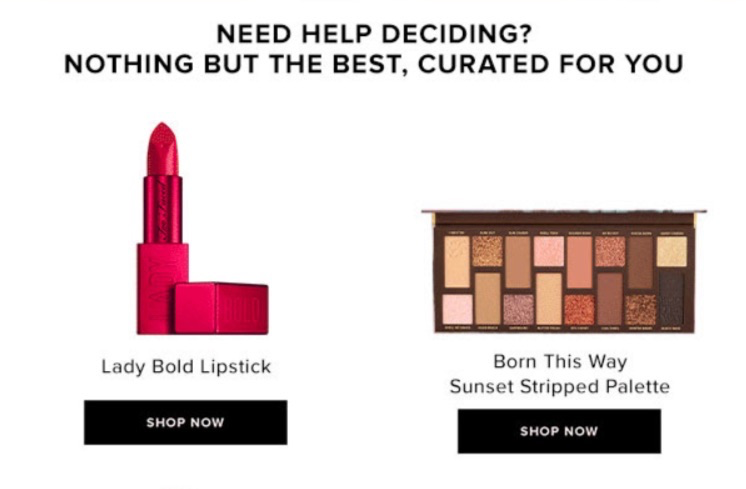
In the awareness stage, it’s a good idea to introduce subscribers to your products in a not-too-salesy way. Sending a list of products curated around a particular theme is a more natural way to pique interest. It’s like a newsletter but for products rather than content.
For instance, you could make the theme seasonal, related to an event, or group your best sellers, as in this example from Too Faced Cosmetics:
6. Brand Story Email
When to use it: Anywhere you need to remind subscribers what the brand stands for. Most often early in a welcome sequence, but the smartest use is as a wrapper around hard news (a price change, a product discontinuation, a policy shift) where brand voice carries more weight than the announcement itself.
goodr makes affordable performance sunglasses and built their reputation on irreverent voice and a $25 price point held for ten years. In November, they used a CEO email to announce their first price increase in a decade.
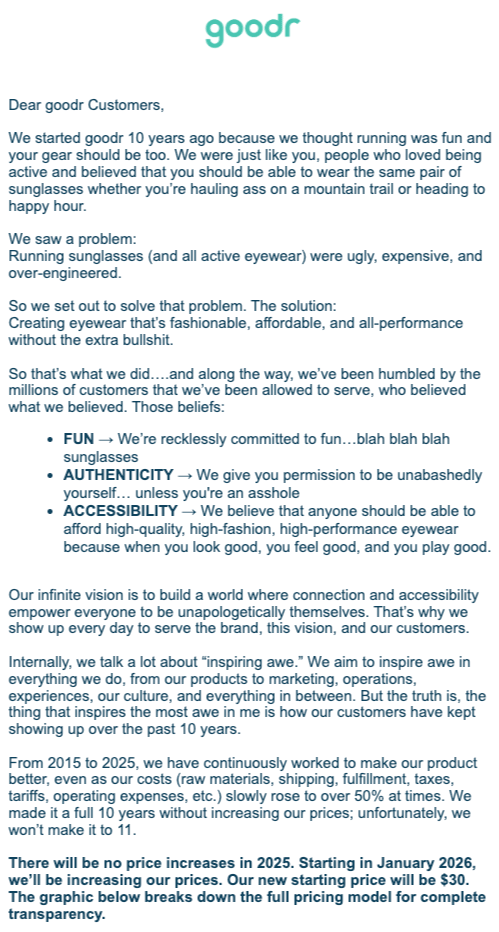 Crucially, they didn't lead with the price news. They led with the brand story.
Three things to copy. The story justifies the news, because by the time the price increase appears, the subscriber has been reminded why goodr matters. The voice is preserved through hard content, with "blah blah blah sunglasses" proving the brand hasn't changed even though the price has. And the CEO signs it personally, then tells customers to go buy at a local retailer if possible. That's a confident move that reframes the increase as long-term posture, not a margin grab.
The structure works for any difficult announcement: lead with why we started, what we believe, what's changing and why, then what you need to know. If you don't have hard news to deliver, don't fake one. But recognize that a brand story email is always more interesting when it's responding to something specific.
7. Lead Magnet Delivery Email
When to use it: Right after someone takes a quiz, downloads a guide, or opts in for any free resource.
A lead magnet delivery email has two jobs and most brands only do the first. Job one: deliver the magnet. Job two: convert the moment of highest intent into a next step. The subscriber just told you what they want. So the email after is the single best place to recommend the obvious next purchase.
Tag is a Texas roaster that runs a coffee preference quiz to help shoppers pick a flavor profile. Their post-quiz delivery email is doing three things at once.
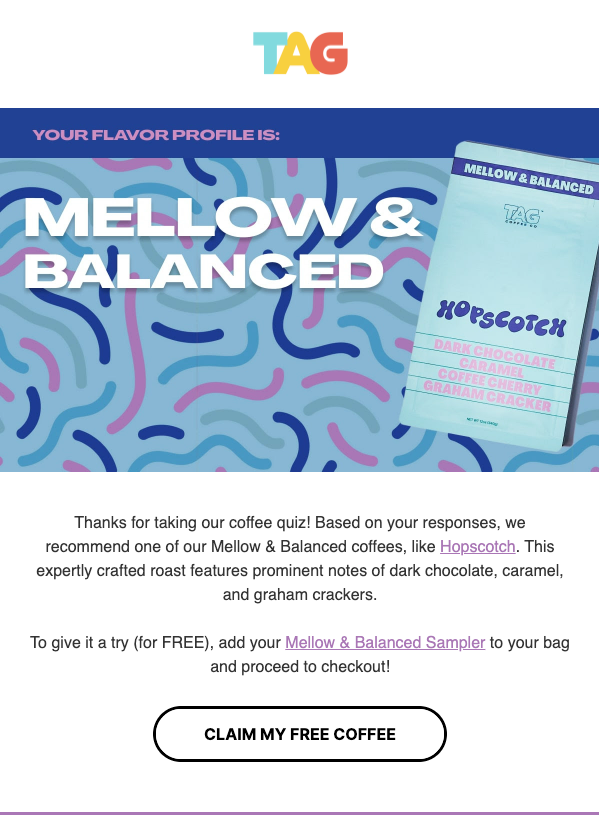
First, a personalized result up top. The subscriber sees their own answer rendered as a label, which makes the rest of the email feel like it's about them.
Second, a specific product recommendation tied to the result: "Based on your responses, we recommend Hopscotch." Not "shop our coffees." One product, with sensory detail.
Third, the free sample as the obvious next step, framed as zero-risk: "To give it a try (for FREE), add your Mellow & Balanced Sampler to your bag.
The quiz itself does three jobs that compound. It collects zero-party data on preferences, creates personalization the subscriber explicitly asked for, and manufactures the perfect setup for the delivery email. By the time the email arrives, the subscriber has already invested attention and self-identified as the customer Tag wants.
If you're running quizzes through Drip's onsite tools, the answers can be stored as custom fields and tags. The quiz, the data capture, and the delivery email all connect without a single manual step.
Part 2: Consideration Stage — Move Them Closer
The subscriber is evaluating you against alternatives or against their own inertia. Emails in this stage need to reduce friction, answer objections, and give the subscriber real reasons to act. You're not introducing yourself anymore. You're making the case.
8. Browse Abandonment Email
When to use it: When a subscriber viewed product pages but didn't add anything to their cart.
Browse abandonment is lower-intent than cart abandonment, so you need a different tone. Lead with helpfulness, not urgency.
Mavi's approach is clean: a "take another look" message featuring the exact products the subscriber browsed, paired with a soft recommendation rather than hard pressure.
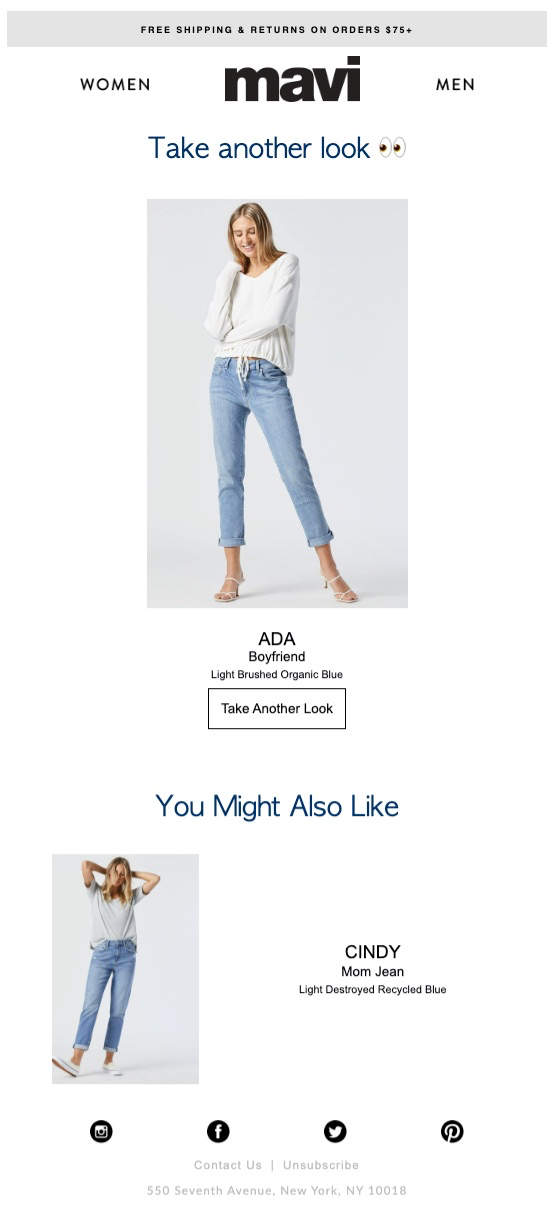
The key distinction here is restraint.
Cart abandoners told you they wanted something. Browse abandoners told you they were curious. Match the energy.
A helpful reminder converts. A high-pressure follow-up after casual browsing feels invasive.
9. Abandoned Cart Email
When to use it: A cart's been created, but there's no checkout. Send the first email within an hour, the second at 24 hours, and the third at 72 hours.
Roughly 70% of online shopping carts are abandoned.
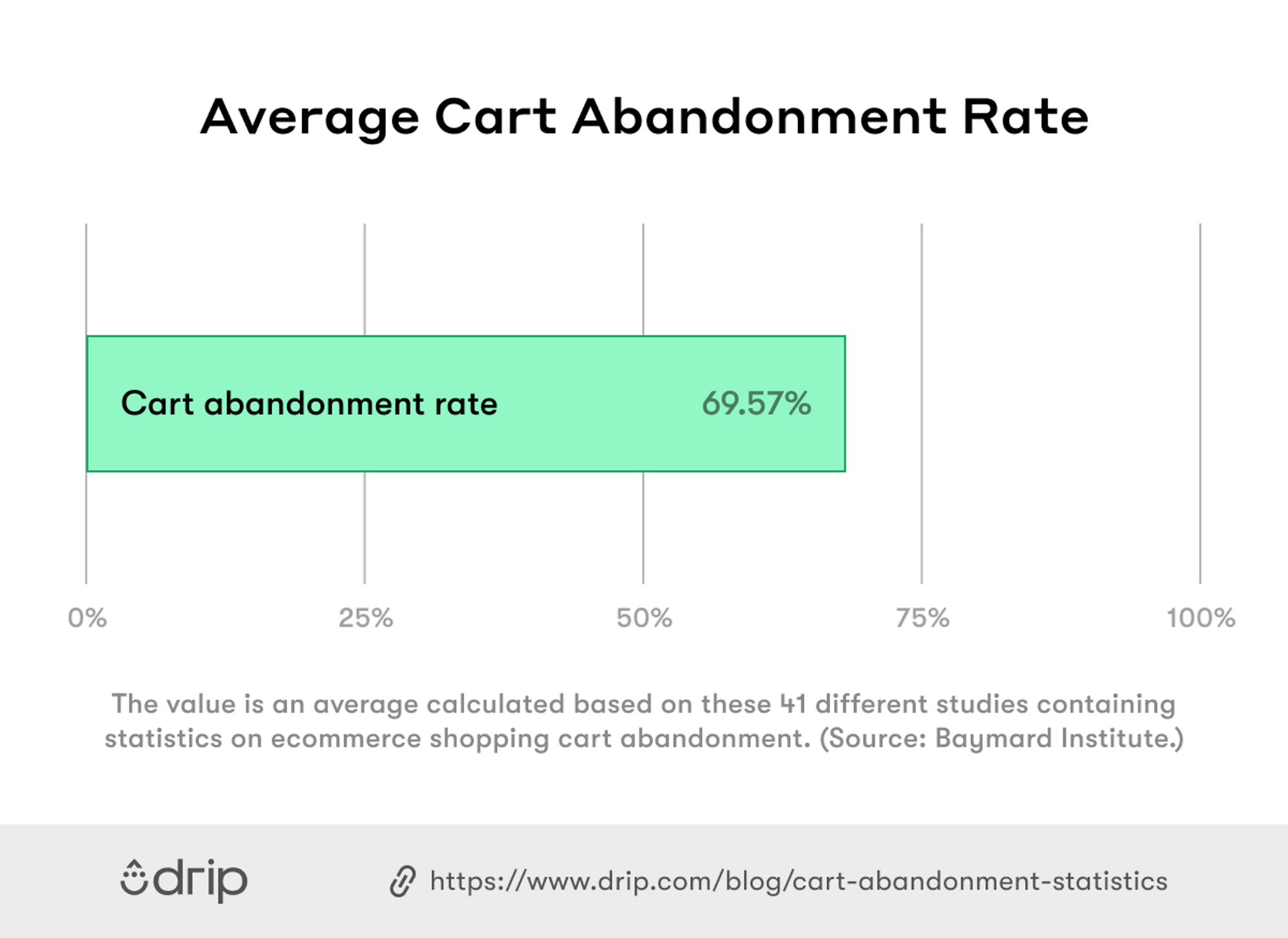 That's not a problem. It's an opportunity for one of the most effective email marketing ideas in your arsenal.
Here, Ayr uses an incentive in the form of a 10% discount to win the customer back. Plus, the brand captures attention with its fun sense of humor:
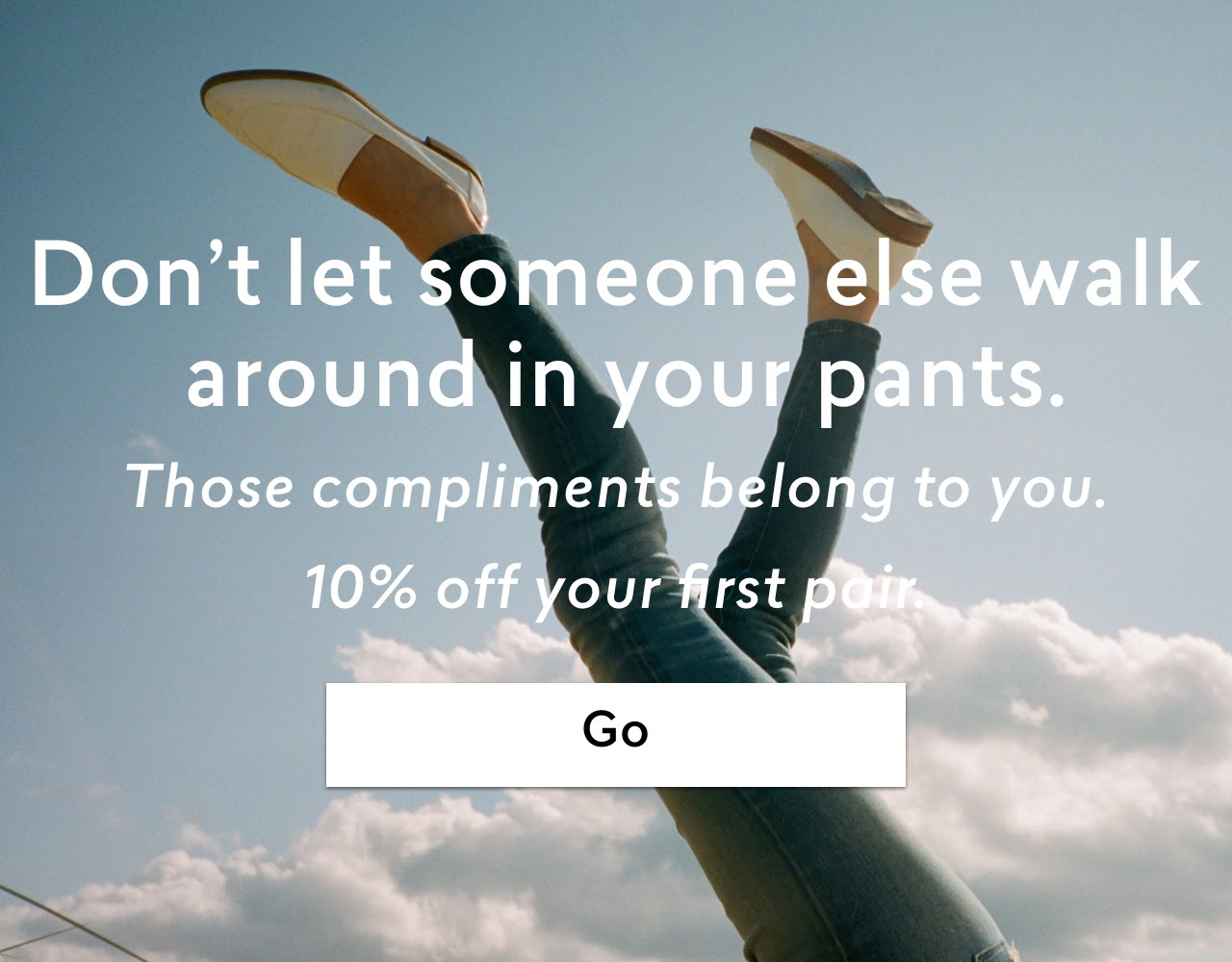 The personality earns the open. The discount closes the sale.
Use discounts with caution, though. Leading with a discount might train subscribers to abandon on purpose, which is a habit you really don't want to create.
10. Back-in-Stock Email
When to use it: When a subscriber opted in to be notified that an out-of-stock item has returned.
This is a high-intent, high-converting email. The subscriber already told you they want this specific product. Your job is to get out of the way.
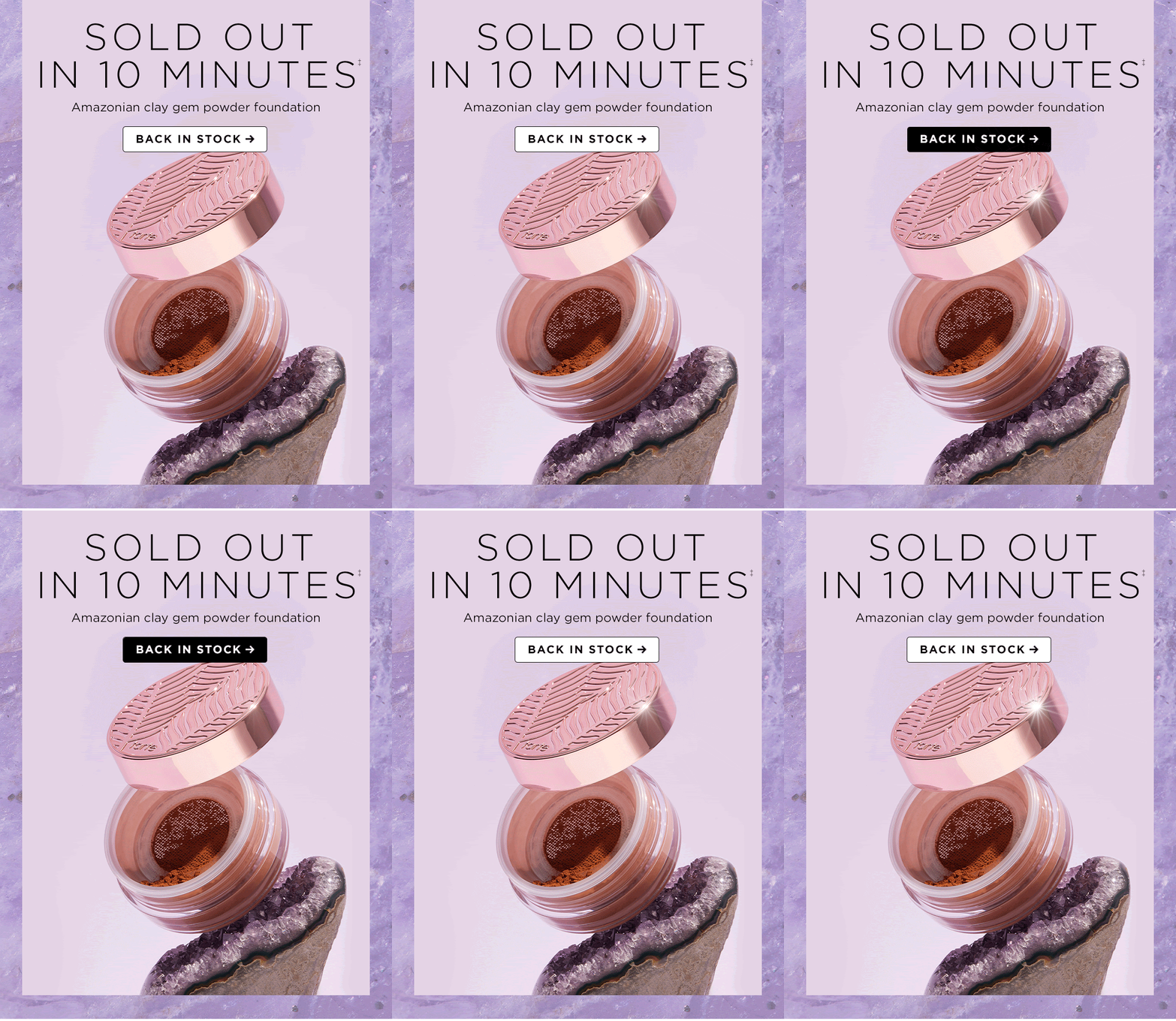
Tarte's back-in-stock email exemplifies the principle: "back, but not for long."
The scarcity is honest (limited restock quantity), the CTA sits above the fold, and there's no wasted space between the notification and the shop button.
Keep the path short. If someone already wants a product, every extra paragraph between them and checkout is friction.
11. Last Chance Email
When to use it: Final hours of a sale, or last units of a limited release.
Genuine scarcity converts. Manufactured scarcity destroys trust.
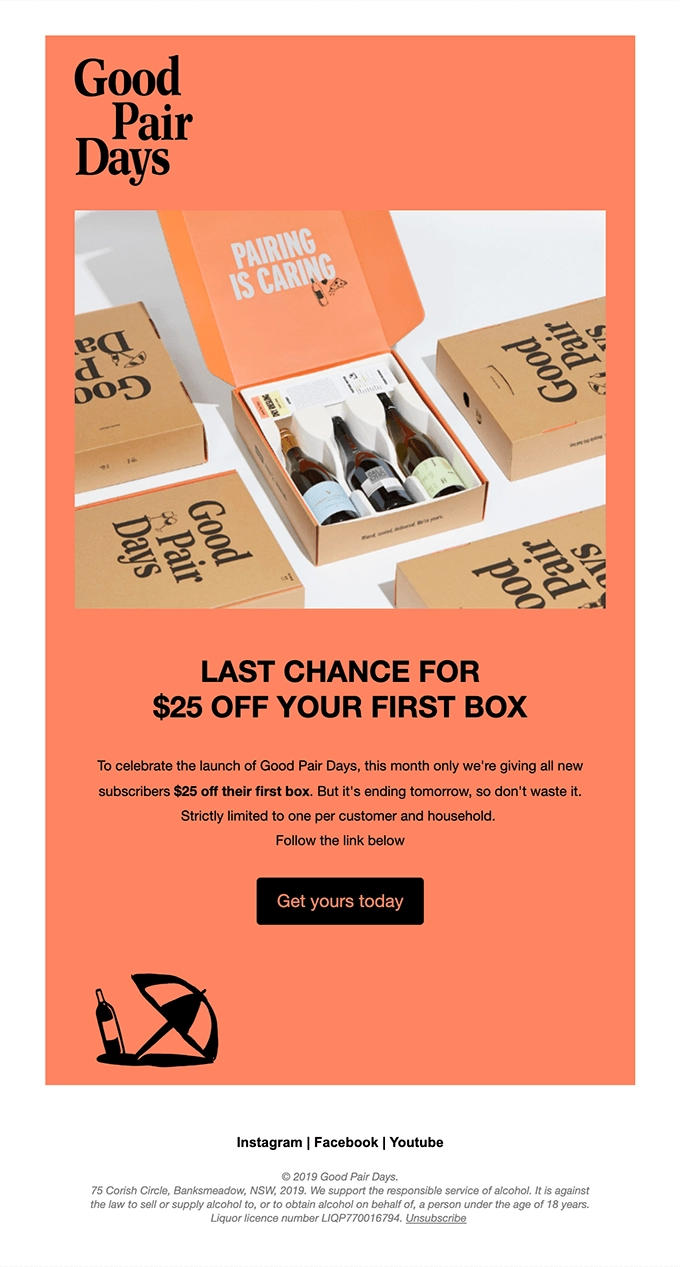 Good Pair Days demonstrates the right way to execute a "last chance" email: the sale is real, the deadline is real, and the framing is "last chance, only chance" rather than a wink-and-nudge "last chance" followed by a sale extension the next day.
If you extend a sale after sending a "last chance" email, you've told your subscribers that your deadlines are fiction. So only send this email when you mean it. For more examples, check out our last chance email examples.
12. Customer Testimonial Email
When to use it: When a subscriber has shown interest but hasn't converted. Testimonials at the consideration stage answer the silent question: "Is this real?"
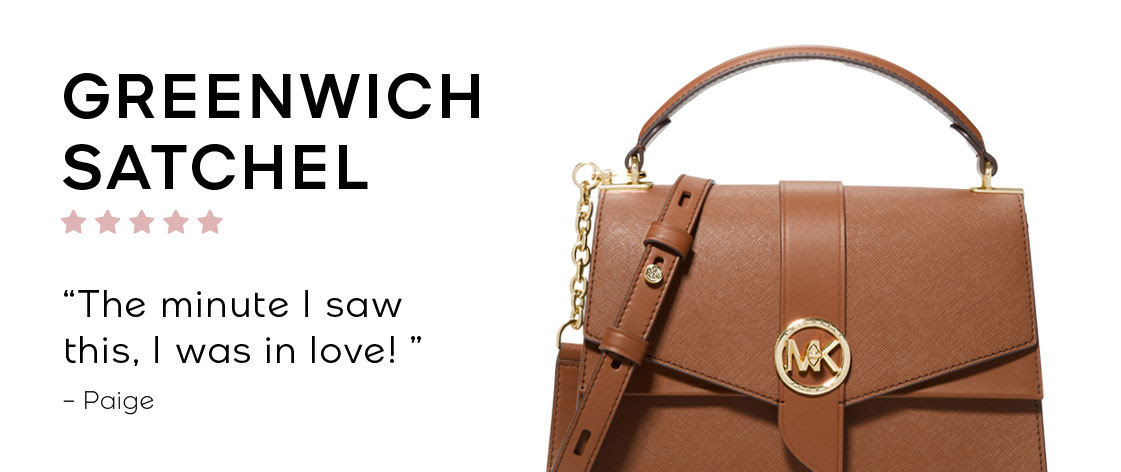 Michael Kors uses customer testimonials that go beyond generic praise.
Specific reviews from real customers (with names, details, and context) outperform polished marketing quotes every time. The subscriber isn't looking for perfection. They're looking for proof from someone like them.
13. Engagement Email
When to use it: When the subscriber needs help making a choice, whether that's fit, formulation, style, or something else entirely.
Levi's fit-guide email turns a common objection ("I don't know which jeans to buy") into an interactive experience.
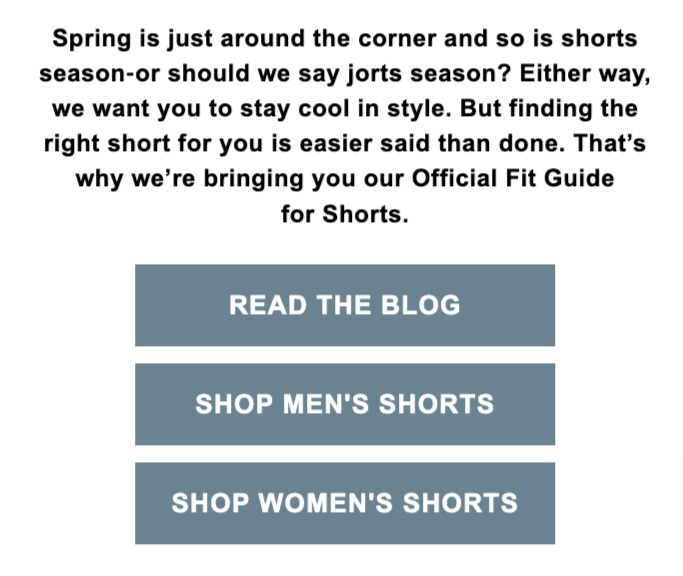 Instead of listing every product and hoping the subscriber finds the right one, the email walks them through a guided decision. That's a creative email marketing idea worth stealing.
The principle: reduce decision friction with tools, quizzes, or product finders. If your subscribers are stuck between options, an interactive email that narrows the choices converts better than a catalog that expands them.
14. New Arrival Email
When to use it: Product drops, new collections, or restocks of a popular line.
"New arrivals!" with no context on why anyone should care is not an email campaign idea. It's a notification.
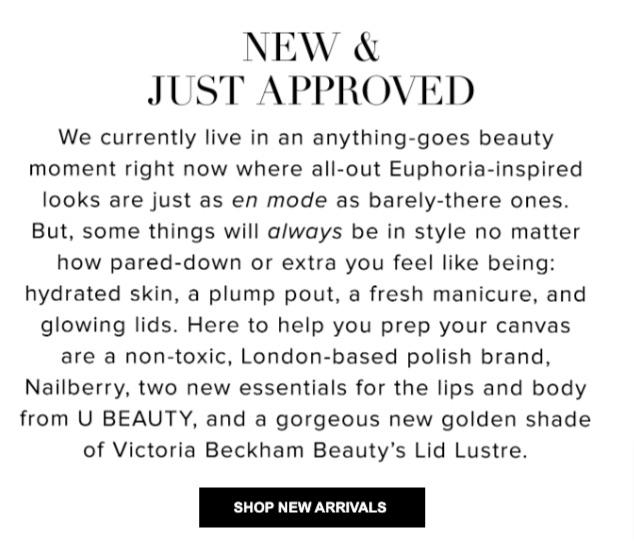 Violet Grey shows the alternative: leading with what makes the product different, not just that it's new. The USP comes first. The product shots follow.
Your subscribers already get plenty of "new product" notifications. The ones that earn a click explain why this matters to the reader. Novelty alone isn't a reason to buy.
15. Informational Email
When to use it: Mid-consideration, when the objections are technical or educational.
Death Wish Coffee sends an email explaining the nuances of their coffee line.
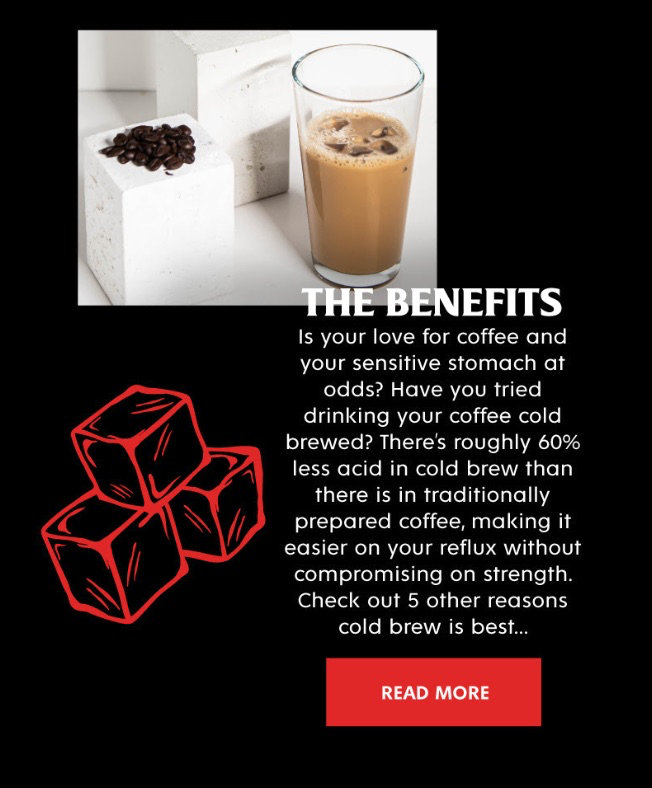
It works because they treat subscribers like they're smart but busy. The email answers the unasked question rather than pitching the product. By the time the subscriber finishes reading, the objection has been dissolved and the CTA feels natural.
Part 3: Conversion Stage — Close the Sale
The subscriber is ready or near-ready. The job of the email now is to remove the last objection and make acting easier than not acting. These email campaign ideas are about clearing the final inch between "I want this" and "I bought this."
16. Discount Email
When to use it: When you need to drive volume and a margin hit is acceptable.
Not all discounts are created equal. A flat percentage off trains subscribers to wait for the next sale. A threshold discount ("$20 off when you spend $75") raises average order value instead of just cutting margin.
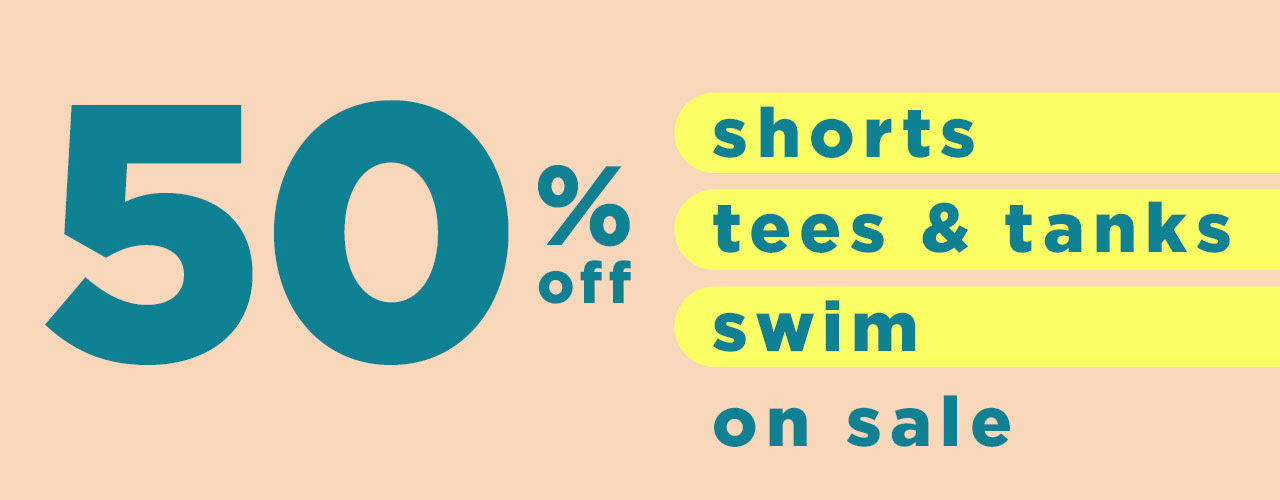
Old Navy's approach demonstrates this well.
Their spend-threshold structure nudges the subscriber to add more to the cart rather than just discounting what's already there.
17. Holiday Email
When to use it: Mapped to the ecommerce calendar (see the seasonal section below).
The principle is to tie your products to the moment, not the other way around. Slapping a holiday graphic on a regular promotional email isn't a holiday email. It's a regular email wearing a costume.
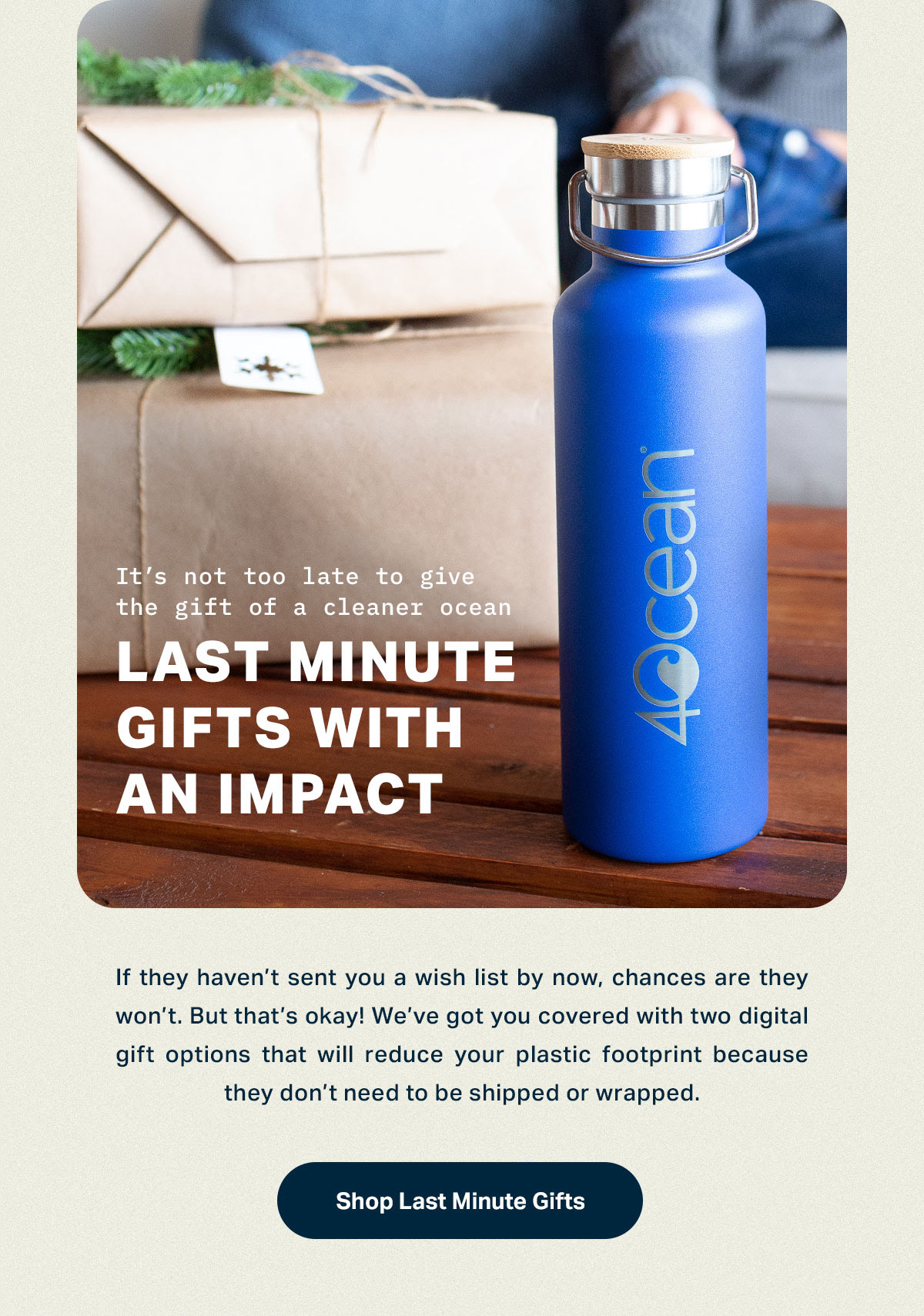
4Ocean's holiday email works because it solves a real problem: last-minute gift ideas for shoppers who procrastinated.
Each product is positioned as the answer to "what do I get them?" rather than a feature list. That's how you tap into holiday urgency authentically.
18. Product Recommendation Email
When to use it: Mid-funnel, when you have behavior data to personalize on.
Personalization beats personalization-flavored copy.
Brooklinen pairs behavior-based recommendations (products the subscriber actually browsed) with an incentive, creating a one-two punch of relevance and motivation.
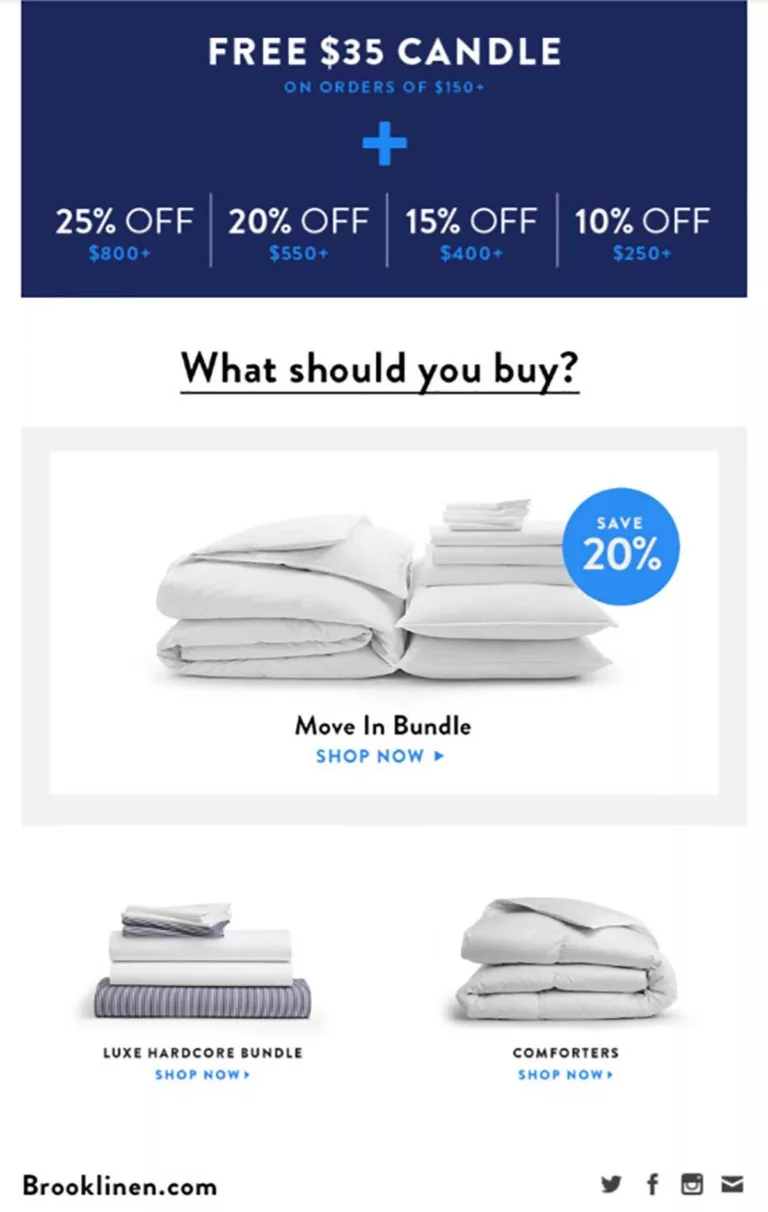
You can use dynamic segmentation and browsing data to populate product blocks with items each subscriber actually viewed, so every recommendation email feels genuinely personal.
19. Countdown Timer Email
When to use it: Time-bound sales, shipping cutoffs, or limited restock windows.
Live countdown timers visualize urgency.
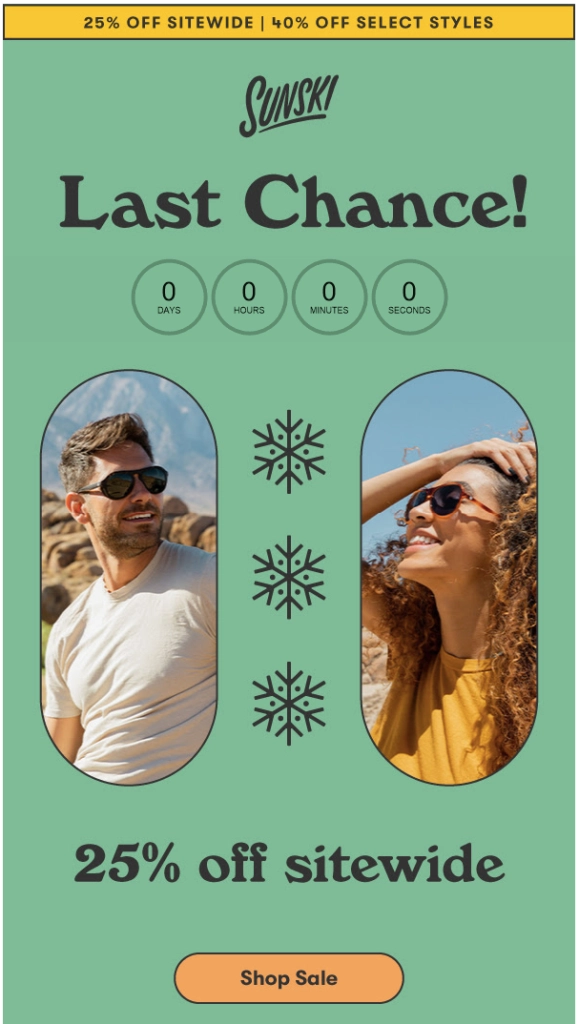
Sunski's approach is straightforward: a ticking timer inside the email counts down to the end of a sale. It's a small detail that creates a measurable lift in click-through rates.
The caveat matters, though. Fake countdowns that reset when the subscriber reopens the email are an instant trust killer. If your timer isn't counting toward a real deadline, leave it out. Real urgency works. Manufactured urgency backfires.
20. Sale Teaser Email
When to use it: One to three days before a sale launches.
The job of a teaser isn't to sell. It's to build a list of pre-warmed buyers who hit the site the moment the sale opens.
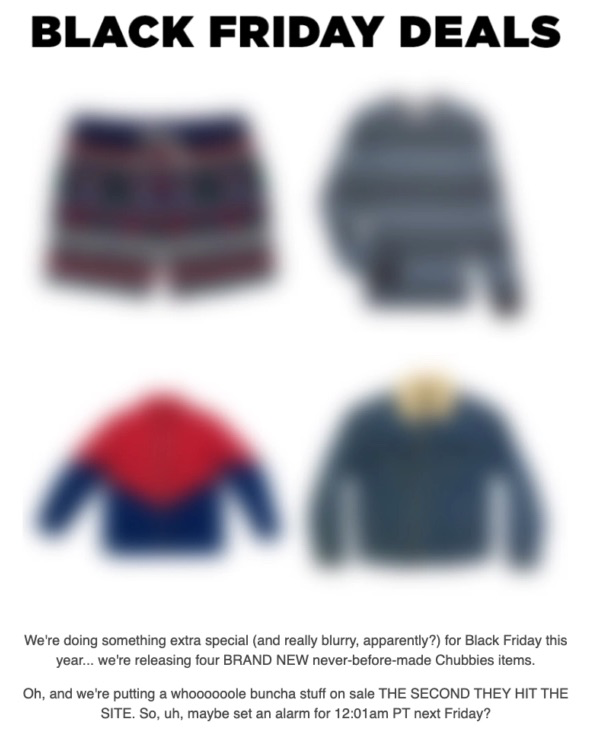
Chubbies demonstrates this with a Black Friday teaser that generates anticipation without revealing the full offer.
21. Upsell Pre-Purchase Email
When to use it: When a subscriber is interested in a single product but their basket is below an AOV threshold like free shipping, gift-with-purchase, or a bundle discount.
Most upsell emails fire after the order's been placed, at which point the subscriber has already finished thinking about the purchase. Pre-purchase upsells work differently. They nudge while consideration is still active and often disguise themselves as browse abandonment with extra cross-sell.
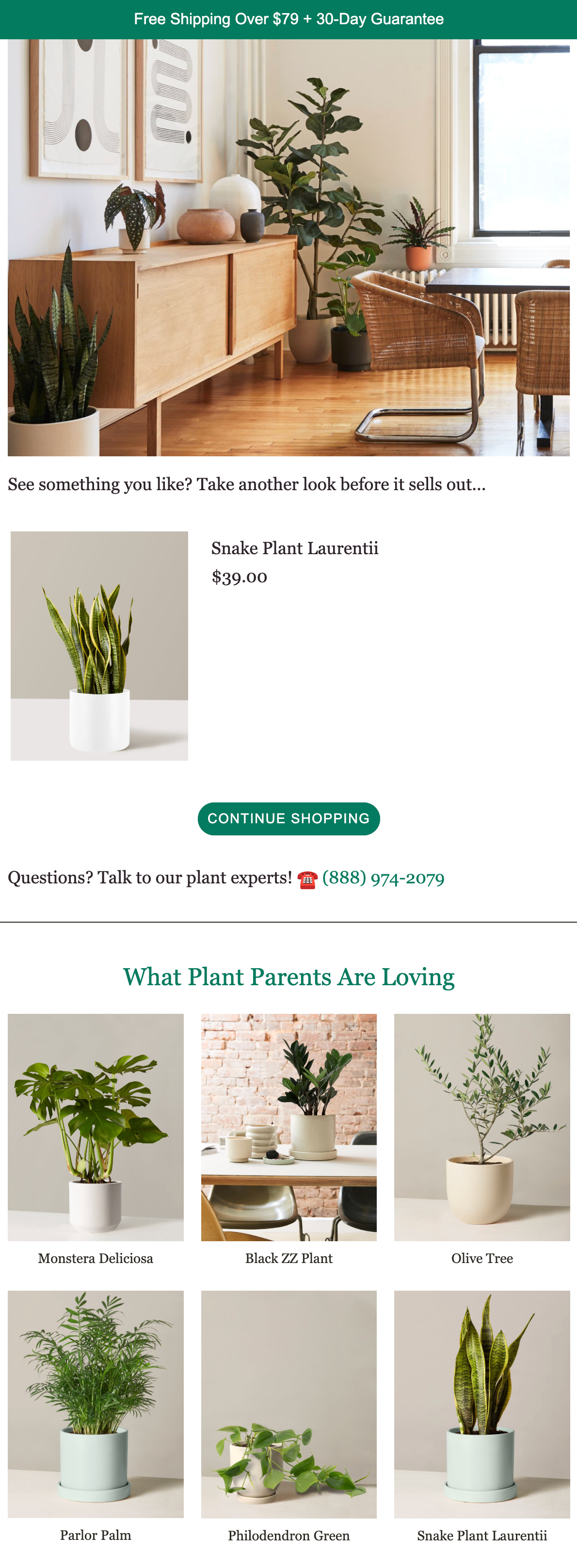
The Sill's follow-up email is technically browse abandonment, but it's structured as an AOV upsell.
Three things to copy here. First, the free shipping threshold creates the upsell logic. The subscriber's $39 plant won't qualify. A second plant will. The email doesn't have to say "buy a second plant." The math does the persuasion, and that's a much lighter touch than the typical "you might also like" block.
Second, the cross-sells are category-coherent. Six plants, same store, same buyer mindset, same care commitment. A subscriber who wants a snake plant might genuinely want a parlor palm. Coherent cross-sells convert because they extend the decision the subscriber was already making.
Third, the trust signals reduce the second-item objection. Plants are a fragile-purchase category. The 30-day guarantee, plant-expert phone line, and free workshops together make adding a second plant feel less risky.
The principle is always the same: surface the threshold, show the browsed item, then offer four to six category-coherent options that get the basket over the line.
Part 4: Retention Stage — Keep Them Coming Back
The customer has bought. The job of email now shifts to driving repeat purchase, increasing lifetime value, and turning buyers into advocates. These email marketing ideas aren't about closing a sale. They're about building a relationship that generates the next ten sales.
22. Thank You Email
When to use it: Immediately after a first purchase, or after a meaningful customer milestone.
The rule here is simple: no CTA. Pure appreciation.
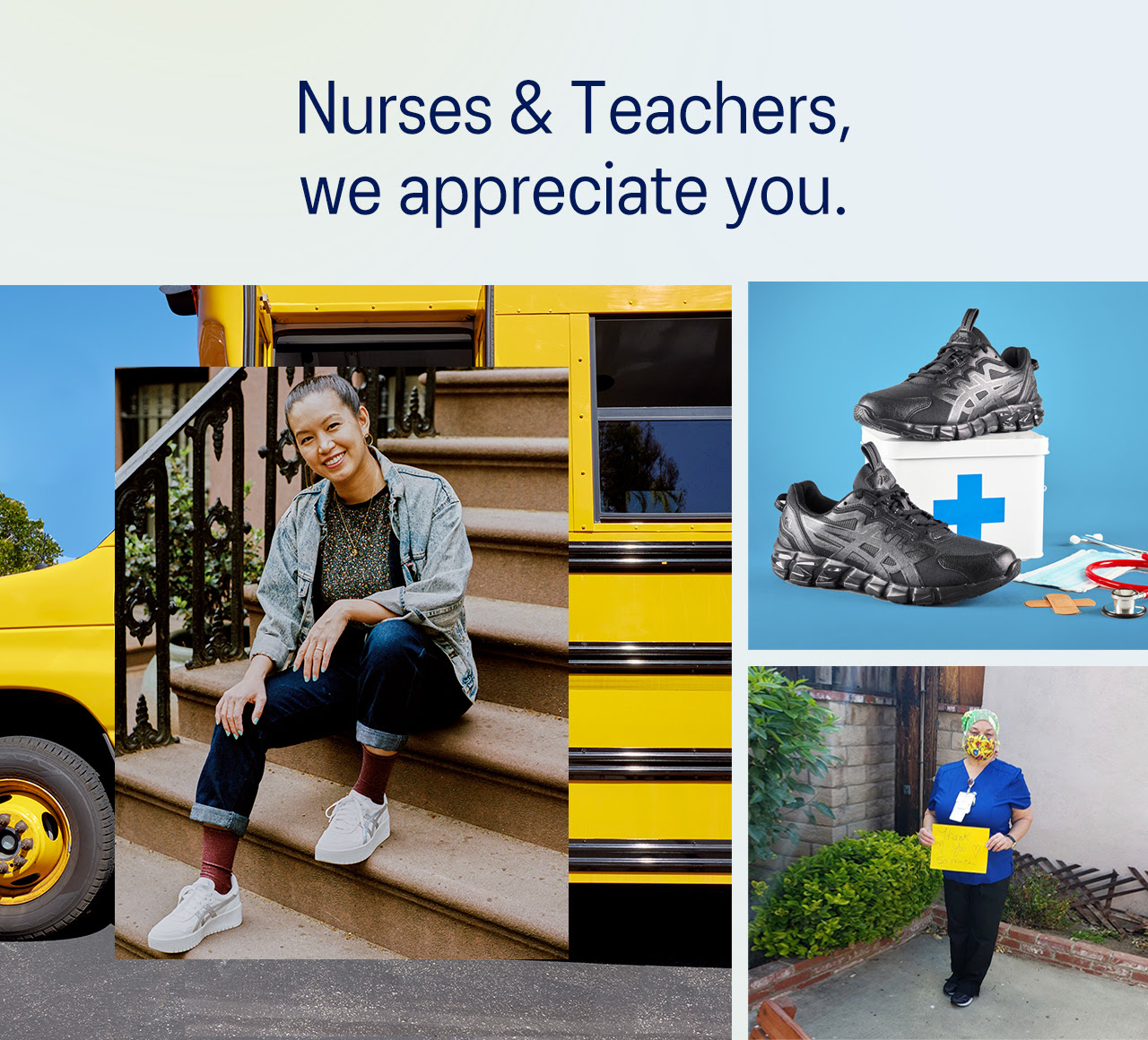
Asics demonstrates this by sending a genuine thank-you to nurses and teachers without any product push or conversion goal. The email exists solely to build trust and goodwill.
23. Giveaway Email
When to use it: Quarterly engagement pushes, or tied to product launches.
The prize must be relevant to your brand. Random iPad giveaways grow a useless list of people who wanted an iPad, not your product.
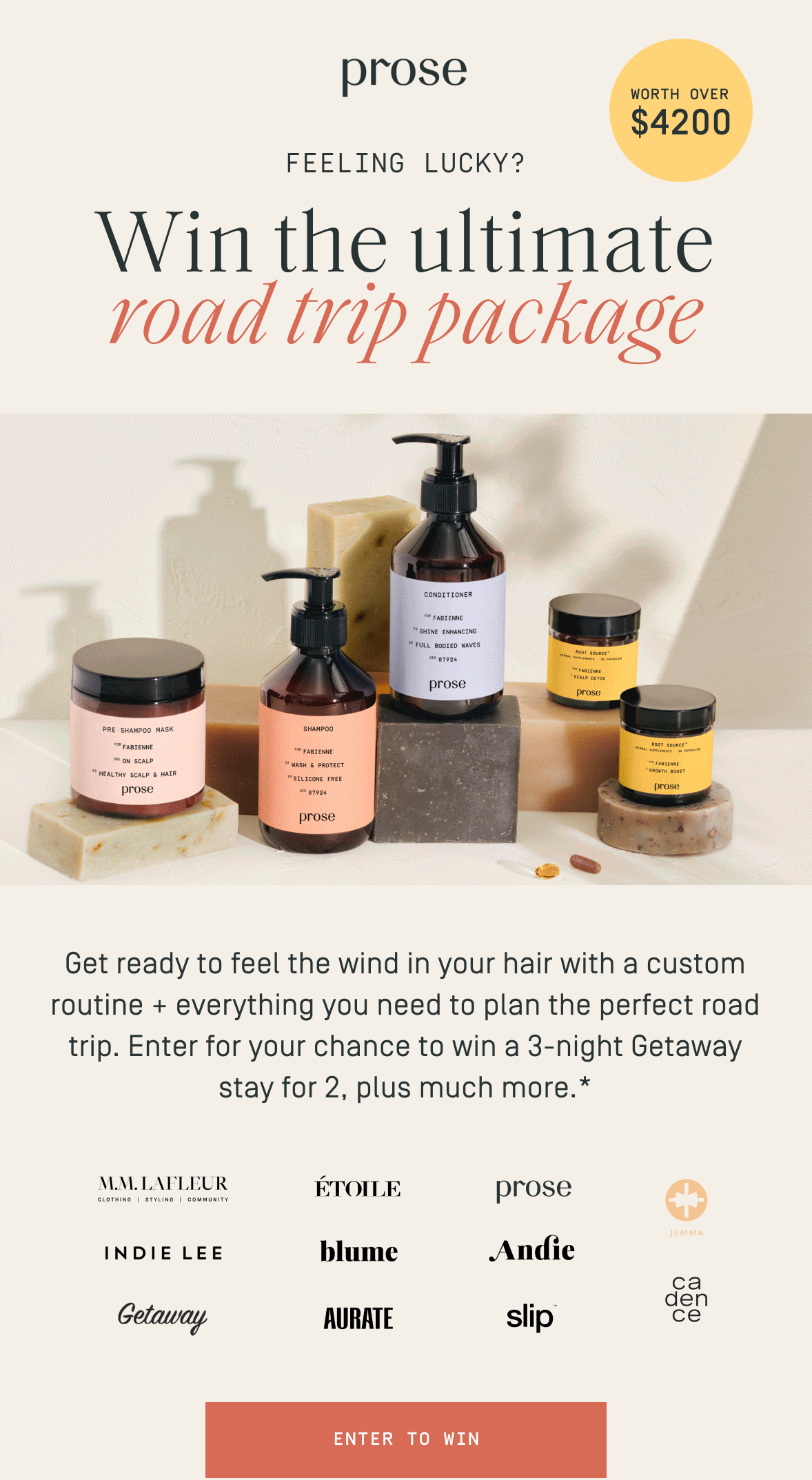
Prose keeps their giveaway on-brand by offering prizes directly tied to their product line.
That means every new subscriber gained from the giveaway has a genuine interest in what Prose sells. A smaller, targeted list of potential buyers is worth more than a large, disengaged list of freebie-seekers every single time.
24. Upsell Email
When to use it: Post-purchase, timed to the product replenishment cycle, or for subscription upgrades.
MeUndies introduces their subscription program early in the customer relationship.
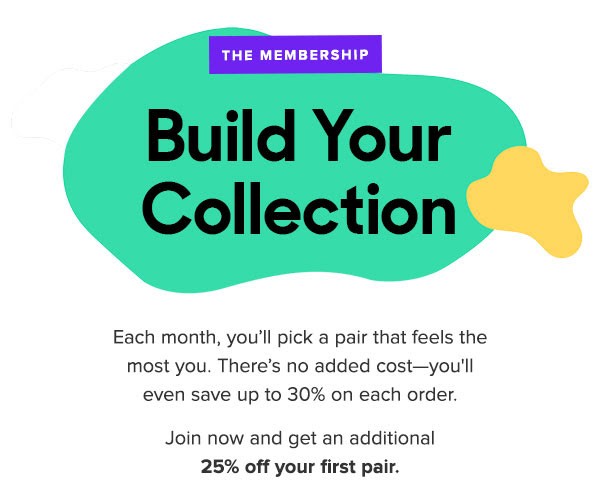
The timing is deliberate: right after a purchase, when satisfaction is highest and the subscriber is most receptive to "get this again, but easier."
Time it to the moment of highest relevance, not the moment most convenient for your send calendar. For more approaches, see our upsell email examples guide.
25. Order Confirmation Email
When to use it: Immediately after purchase.
Order confirmations are among the highest-opened emails you'll ever send. Use the real estate wisely.
ASOS confirms the order and sets expectations, then surfaces secondary actions: app download, style content, and preference updates.
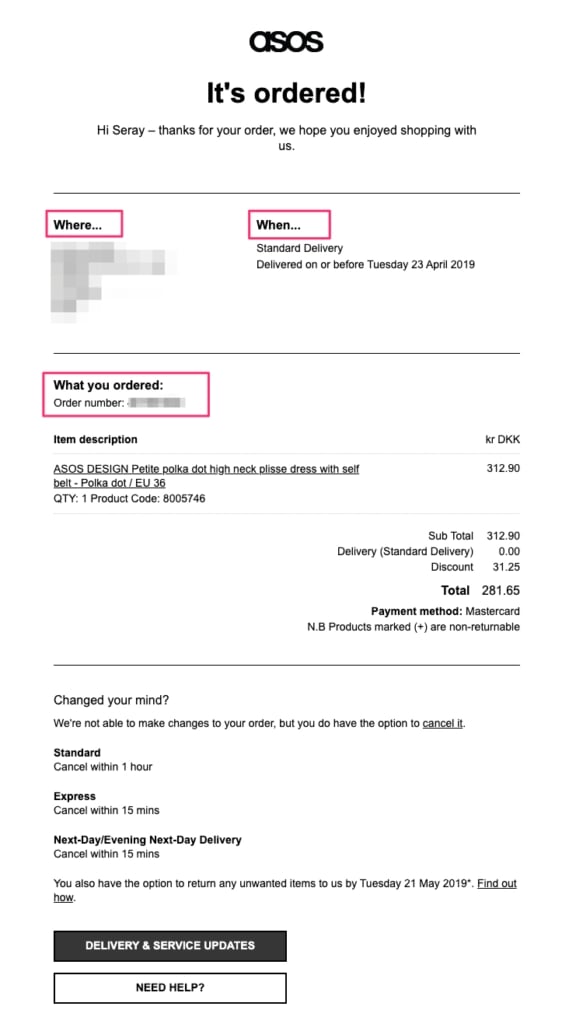
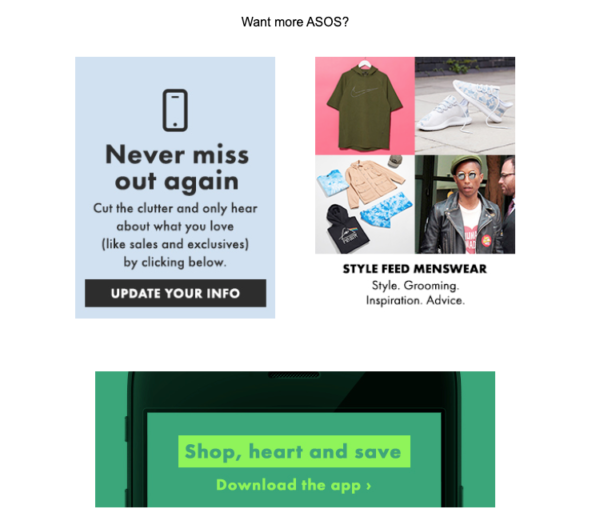
A stripped-down system email wastes that open.
You don't need to turn the confirmation into a sales pitch, but one secondary action (an app download, a referral prompt, or a related product suggestion) takes advantage of a moment when the subscriber is actively paying attention. For more strategies, check out our order confirmation email guide.
26. Customer Appreciation Email
When to use it: Loyalty milestones like a one-year anniversary, Nth purchase, or VIP tier achievement.
Recognition costs nothing and builds disproportionate loyalty.
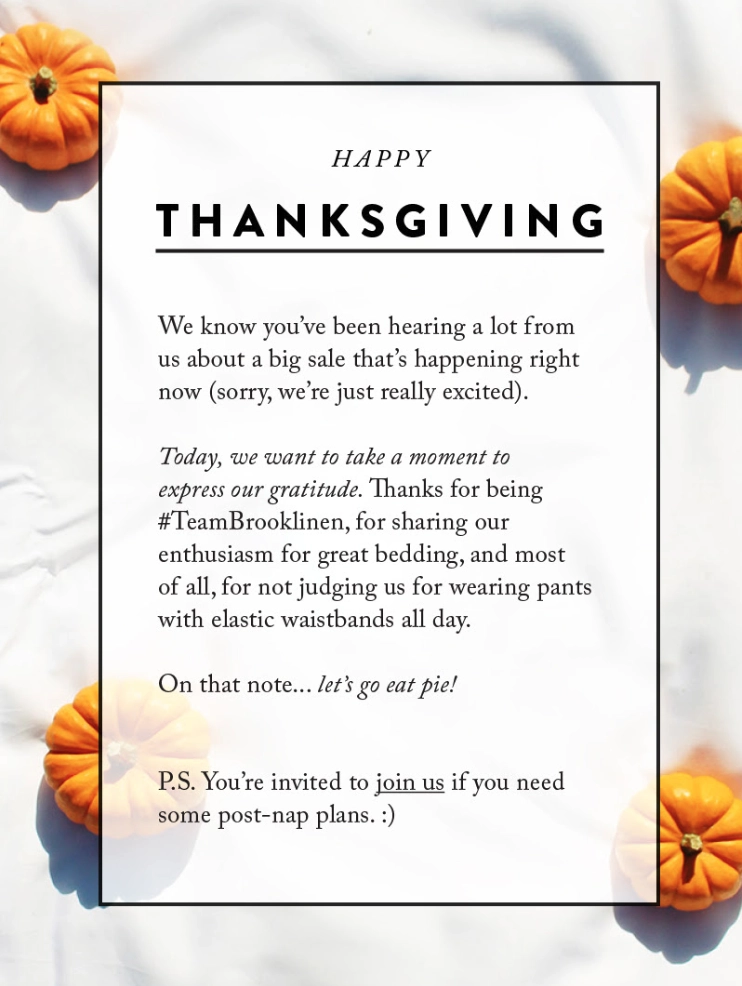
Brooklinen's appreciation email is straightforward: a genuine thank-you for being a subscriber, without turning the gratitude into a discount in disguise.
27. Referral Email
When to use it: Post-purchase, after a positive moment like delivery confirmation or a high NPS response.
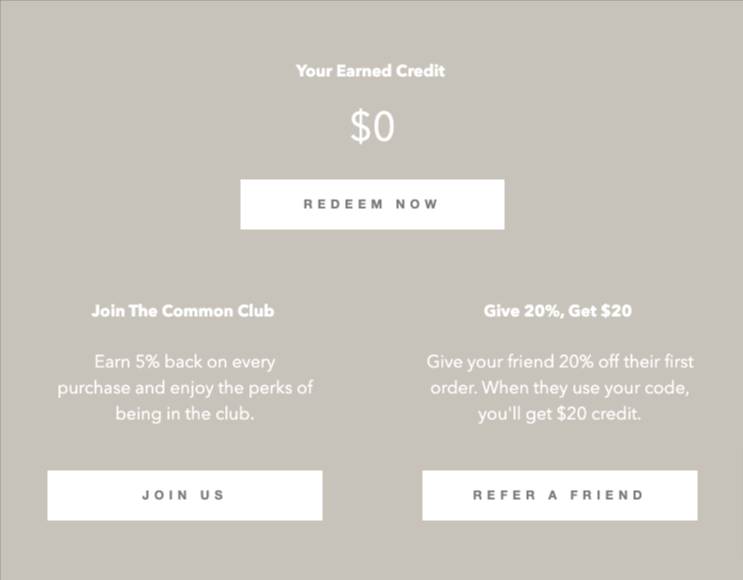
Two-sided incentives (giver and receiver both get something) typically outperform one-sided ones.
Taylor Stitch builds this into their referral email with a clear value proposition for both parties.
28. Birthday Email
When to use it: On the subscriber's birthday (you'll need to capture their date of birth at signup or via a preferences center).
Make the gift feel personal, not transactional.
Birchbox sends a $10 birthday reward with a $50 minimum spend. That threshold lifts AOV while the birthday framing keeps it feeling like a gift rather than a promo code.
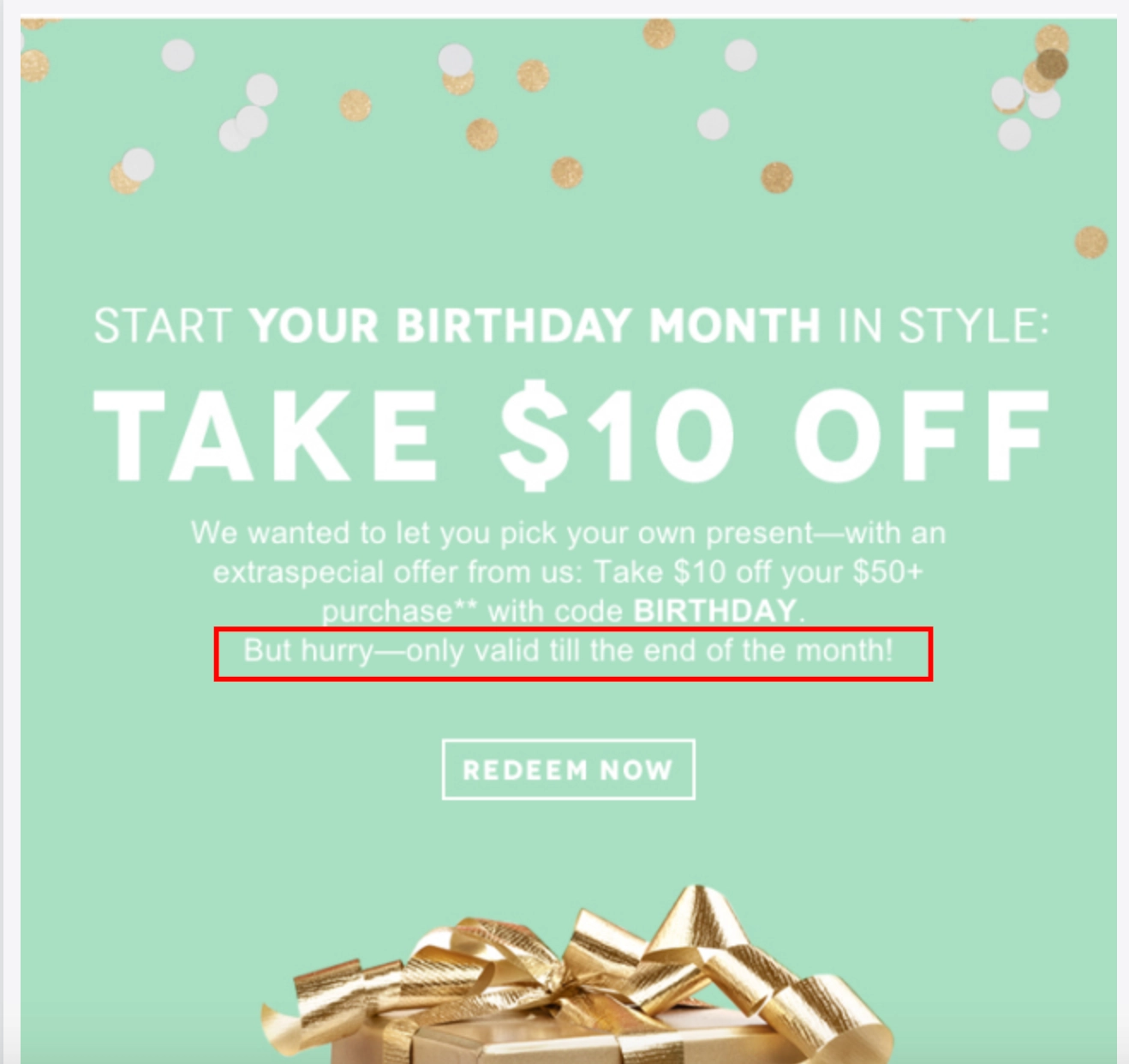
In Drip, date-based delays in your automation workflows let you trigger the email at the right moment every time.
29. Funny Email
When to use it: Anywhere a regular promotional email would go. Voice doesn't replace the offer. It carries the offer past the inbox-glaze that kills 90% of promotional sends.
Brand voice is a moat. Subscribers stay on the list because of how it feels to read. The strongest funny emails aren't trying to be funny in a bolted-on way. They treat humor as the structural choice and let the offer ride underneath it.
A useful test: if you removed the joke, would the email still work as marketing? If yes, the joke's decoration. If no, the joke is the engine.
Liquid Death sells canned mountain water with a death-metal aesthetic. This Memorial Day email is one of the cleanest examples of voice-as-engine in DTC email.
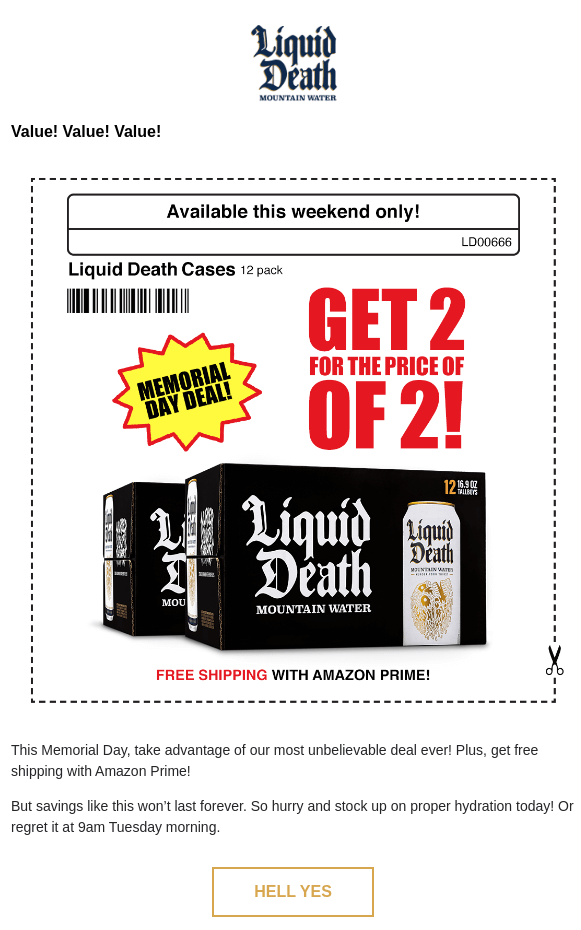
Three things to copy. First, the joke is the email's structural choice. Strip the humor and there's no email, no actual deal, no actual urgency, no reason to click.
Second, it still does the marketing job. Underneath the parody, this is a real Memorial Day promo. Liquid Death participates in Memorial Day retail without sounding like every other brand.
Third, the CTA carries the voice through to the click. "HELL YES" is doing more than "Shop Now."
The lesson isn't "be like Liquid Death." The lesson is to pick a voice your team can sustain across every touchpoint and let it do real structural work.
30. Social Responsibility Email
When to use it: Tied to real action, whether that's a campaign launch, a donation milestone, or a sustainability report.
Specific actions and numbers are everything here.
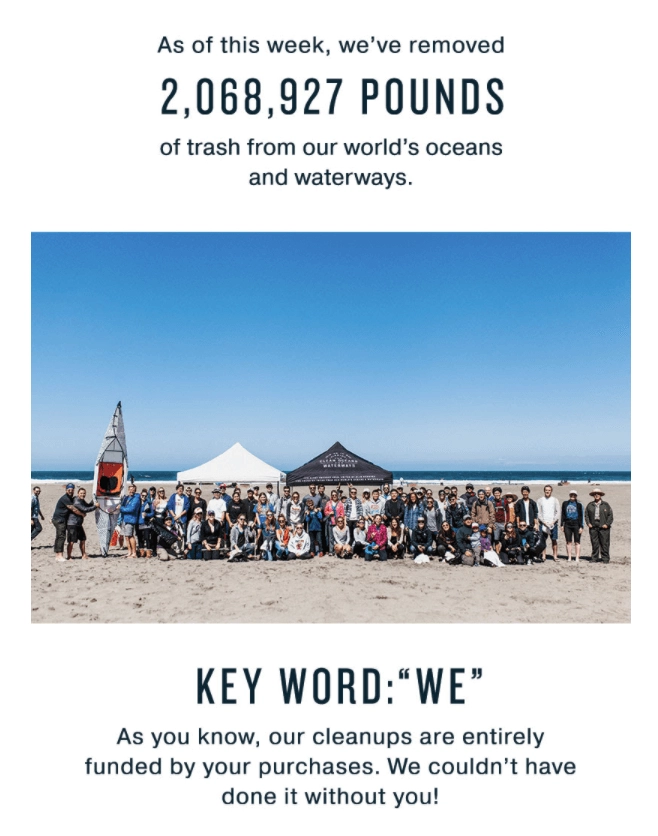
United By Blue doesn't say "we care about the ocean." They show exactly what they've done and quantify the impact. That specificity is the difference between a brand that walks the talk and a brand that sounds like every other vague values statement in the inbox.
31. Survey Email
When to use it: Post-purchase (roughly two weeks after delivery) or annually for relationship health.
Make it short. One to three questions get dramatically higher completion rates than ten.
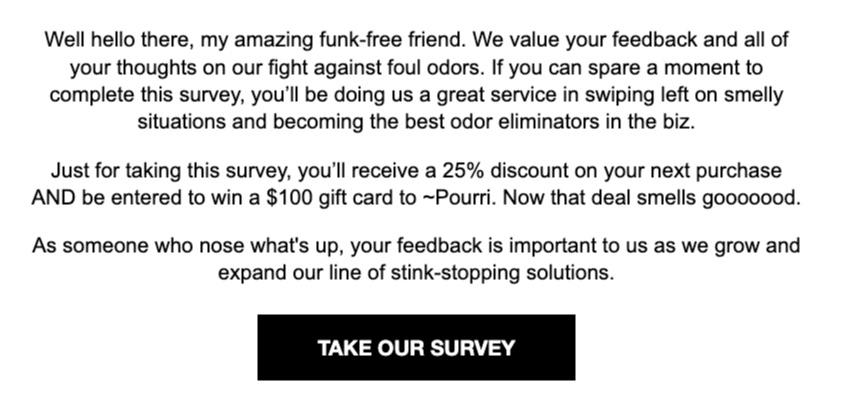
Poo~Pourri incentivizes completion with 25% off plus a free prize draw, which turns a favor into a fair exchange.
32. Win-Back / Re-engagement Email
When to use it: Subscribers who haven't opened or purchased in 60 to 120 days.
Most win-back emails pile on a bigger discount and beg for a click. That works occasionally but trains the rest of your list to disengage and wait for the desperation discount. The smarter move is to flip the script: put the subscriber in control. Stay or leave, both are okay.
Psilly Goose is a small functional-mushroom drinks brand. Their re-engagement email isn't a discount push. It's an invitation to opt out, written by the founders, that respects the subscriber's attention more than the subscriber probably expects.
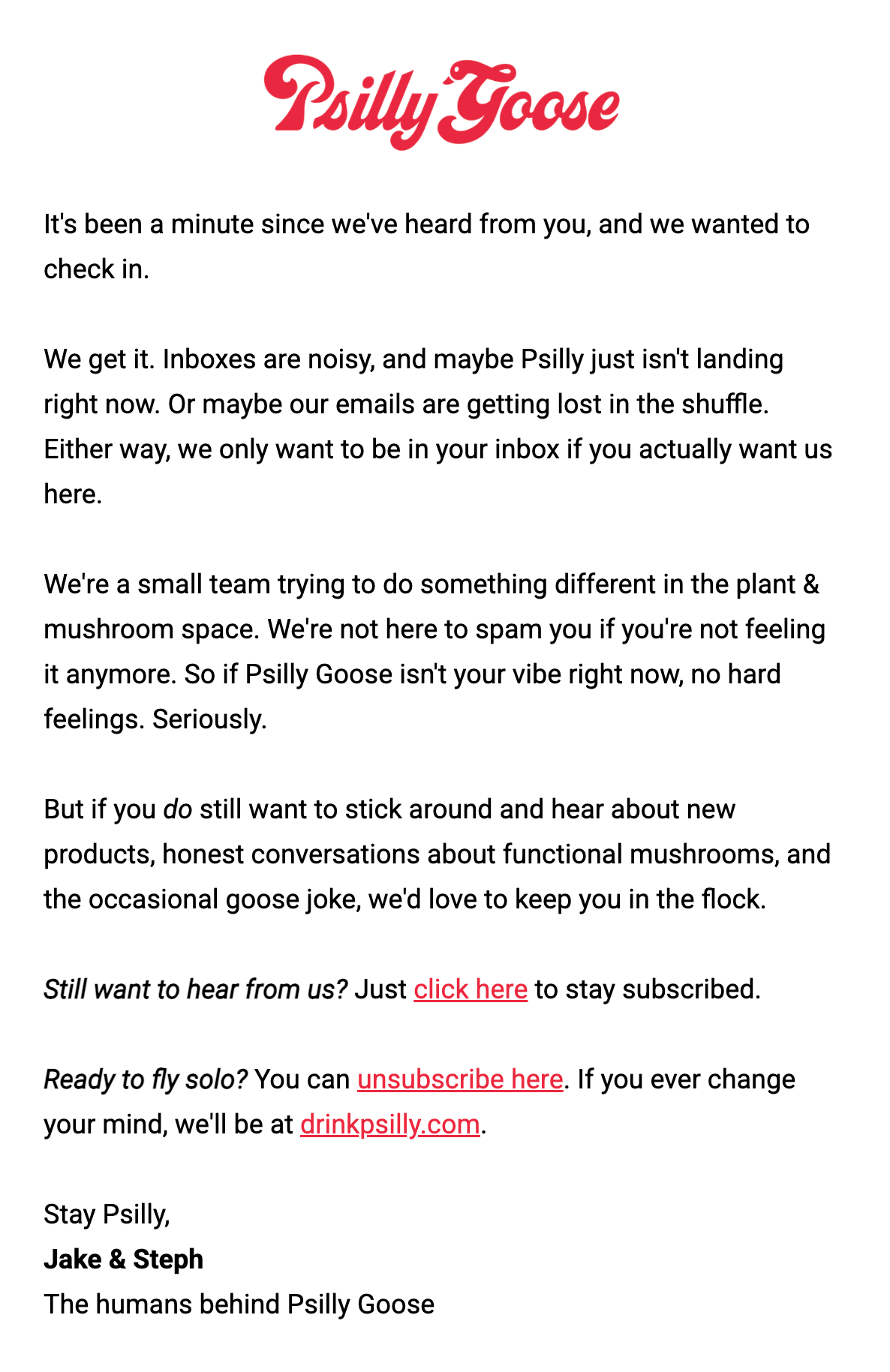
Three things to copy. First, it treats unsubscribing as a legitimate option, not a failure. Most re-engagement emails hide the unsubscribe in tiny grey text. Psilly Goose makes it a full CTA. That posture increases the people who actively re-confirm, because the choice is now real rather than passive. It also cleans the list of people who were going to leave anyway, which raises deliverability for everyone who stays.
Second, the reasons given for disengagement are the subscriber's reasons, not flattering self-reflection. "Maybe Psilly just isn't landing right now" isn't the brand fishing for compliments. It's the brand naming what's actually happening. That honesty is rare enough to earn the read.
Third, the personal sign-off does work the brand can't fake. For small brands, "the humans behind Psilly Goose" is a real edge.
This pattern works best as the second touch in a re-engagement sequence. The first email can pitch a discount or new product to wake the subscriber up. If they still don't respond, this email runs as the cleanup before automatic suppression.
In Drip, you can build this as a workflow with a decision node: "Opened previous re-engagement email?" leads to the discount path or the graceful-exit path.
Seasonal and Holiday Email Marketing Ideas
The best email marketing ideas aren't just good in isolation. They're timed to the moments when your subscribers are already in a buying mindset. Here's how to plan your year around the ecommerce calendar.
Winter
Winter is peak revenue season for most ecommerce brands, and the inbox competition is fierce. Start early, send with purpose, and don't wait until December 20th to launch your holiday campaigns. This is where your highest-volume sends live.
For specific campaign inspiration, explore our guides to holiday email examples, holiday subject lines, Cyber Monday emails, winter email campaigns, Valentine's Day emails, and Valentine's Day marketing strategies.
Spring
Spring is less crowded, which is an advantage. With Mother's Day as the anchor, you have a window where subscribers are receptive but not fatigued from holiday bombardment. Use it for fresh product launches and list-nurturing campaigns that build toward summer.
Check out our spring email examples, spring subject lines, and Mother's Day email examples.
Summer
Summer's slower pace is an opportunity, not a problem. Use it to test new email campaign ideas, run engagement series, and invest in the kind of content-driven newsletters that build loyalty quietly. The brands that nurture in summer win in Q4.
For seasonal inspiration, see our summer email campaigns and summer email subject lines.
Fall
Fall is the run-up to peak season. This is where you finalize your automations, warm your list, and launch teaser campaigns for Black Friday. Think of September and October as rehearsal months for the main event.
Get ahead with our guides to fall email campaigns, fall email subject lines, Halloween emails, Thanksgiving emails, and Black Friday email strategies.
Put These Email Marketing Ideas Into Action
Every idea on this list comes down to the same thing: sending the right email to the right person at the right moment in their journey. That's easier said than done if you're piecing together tools that weren't built for the job.
Drip is an ecommerce email platform built specifically for this kind of lifecycle marketing. Use the Visual Email Builder to design any of the campaigns above. Use dynamic segmentation to make sure each email reaches the right lifecycle stage. And use visual workflows to automate the sequences so they run while you sleep.
Try Drip free for 14 days. No credit card required.