Send your first abandoned cart email about one hour after a shopper leaves. That window is soon enough to catch active buying intent while the product is still fresh in their mind, yet late enough that the message doesn't feel pushy. Waiting longer than a day causes recovery rates to drop sharply.
When is the best time to send the first abandoned cart email?
About one hour after abandonment is the sweet spot for most stores. The shopper still remembers what they wanted, and they're often still deciding.
Send it too soon, at five or ten minutes, and you can come across as creepy or trigger an email before the order has even finished processing. Send it too late, and the intent cools off.
According to Rejoiner's analysis of cart recovery campaigns, an hour after abandonment consistently lands near the top for conversions. One hour is a safe default you can test from.
Why does timing matter so much for abandoned cart emails?
Buying intent has a short shelf life. The closer your email lands to the moment someone abandoned, the more likely they are to pick up where they left off.
Wait too long and that intent fades. Data compiled by Barilliance shows recovery rates fall off steeply once you pass the 24-hour mark, with conversions roughly halving compared to emails sent within the first hour.
So timing isn't a minor setting. It's one of the biggest levers you have on how much abandoned revenue you actually win back.
How long should you wait between abandoned cart emails?
One email rarely does the job. A short series of three usually recovers far more than a single send, and the spacing matters as much as the first send time.
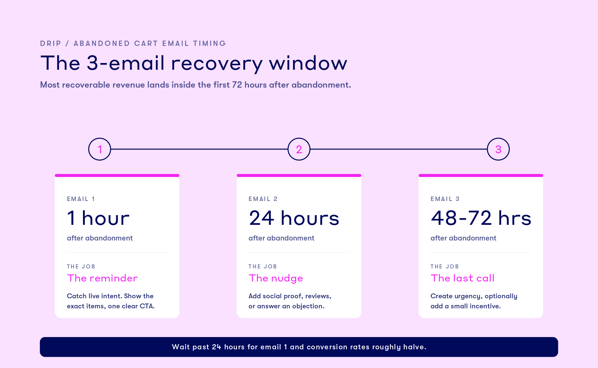
Send the second email about 24 hours after abandonment and the third around 48 to 72 hours out. After that 72-hour window, you're mostly nagging people who've moved on.
| When to send | What it does | |
|---|---|---|
| Email 1 | ~1 hour after abandonment | A simple reminder. Show the exact items and one clear link back to the cart. |
| Email 2 | ~24 hours after abandonment | Add a nudge: reviews, social proof, or an answer to a common objection. |
| Email 3 | 48 to 72 hours after abandonment | The last call. Create urgency, and optionally add a small incentive. |
Does the best timing change by industry or cart value?
Yes, a bit. The one-hour first send is a strong default, but high-consideration purchases give you more room to breathe.
For furniture, electronics, or anything with a long research cycle, shoppers expect to mull it over. A slightly later first email and a longer tail (stretching email three out to four or five days) can work better.
For impulse buys and lower-priced items, speed wins. Hit them fast while the urge is still there, and keep the whole series inside 72 hours.
What does good abandoned cart email timing look like in practice?
So what does this look like once it's running?
Picture a Shopify store with 1,000 abandoned carts a month at an $80 average cart value.
They build a three-email series timed to the recovery window below: a reminder at one hour, a nudge at 24 hours, and a last call at 48 to 72 hours.
If that series recovers even 10% of those carts, that's 100 orders and $8,000 in monthly revenue that would otherwise have vanished.
Drip customer Nifty Gifts saw what tight timing can do: a 46% open rate on their abandoned cart workflow helped drive a 77% revenue increase in two months.
The bottom line on abandoned cart email timing
Start with one email at one hour, then space the next two across the first 72 hours. That single window is where most recoverable revenue lives, so getting the timing right matters more than almost anything else in the email.
The good news?
You set it up once and it runs on autopilot for every cart that slips away. If you want a platform that triggers the first email the moment a cart goes quiet, you can try Drip free and have your sequence live in an afternoon.