You're trying to pick an email platform that actually drives sales, and every comparison reads like a spec sheet. The Klaviyo vs Mailchimp debate comes up constantly, because these two sit at opposite ends of the market. One was built for ecommerce. The other was built for newsletters.
So which one fits your store? It depends on where you are and where you're headed.
Let's break down how they really compare, where each one wins, and where each one quietly costs you money.
The short answer? Klaviyo is the stronger pick for ecommerce automation, deep segmentation, and revenue tracking, while Mailchimp is better if you want simple, low-cost email and broad general-purpose marketing. But plenty of growing brands outgrow both, and a purpose-built alternative like Drip often delivers Klaviyo-level ecommerce power with less complexity and more transparent pricing.
What You'll Find in This Post
Klaviyo vs Mailchimp at a Glance
Here's how the two stack up on the things that matter most to an online store.
| Feature | Klaviyo | Mailchimp |
|---|---|---|
| Best for | Ecommerce brands serious about automation | Beginners and general small-business email |
| Built for ecommerce | Yes, from the ground up | No, newsletter roots with ecommerce add-ons |
| Ecommerce automation | Advanced (cart, browse, post-purchase) | Basic on Standard, limited depth |
| Segmentation | Granular, behavior and purchase based | Predictive on higher tiers, less flexible |
| Revenue attribution | Strong, tied to store data | Limited |
| Native SMS | Yes | Limited and region dependent |
| Pricing model | Active profiles you can email | Total contacts, including unsubscribed |
| Ease of use | Steeper learning curve | Beginner friendly |
| Free plan | Up to 250 active profiles | Up to 250 contacts (cut in Jan 2026) |
The table tells the headline story. But the nuance is in how each one feels once your list and your order volume start to grow.
Klaviyo: The Ecommerce Heavyweight
Klaviyo built its reputation on ecommerce. It plugs into your store, pulls in purchase and browsing data, and lets you trigger emails and texts off almost any shopper behavior. For a data-hungry marketer, that's powerful.
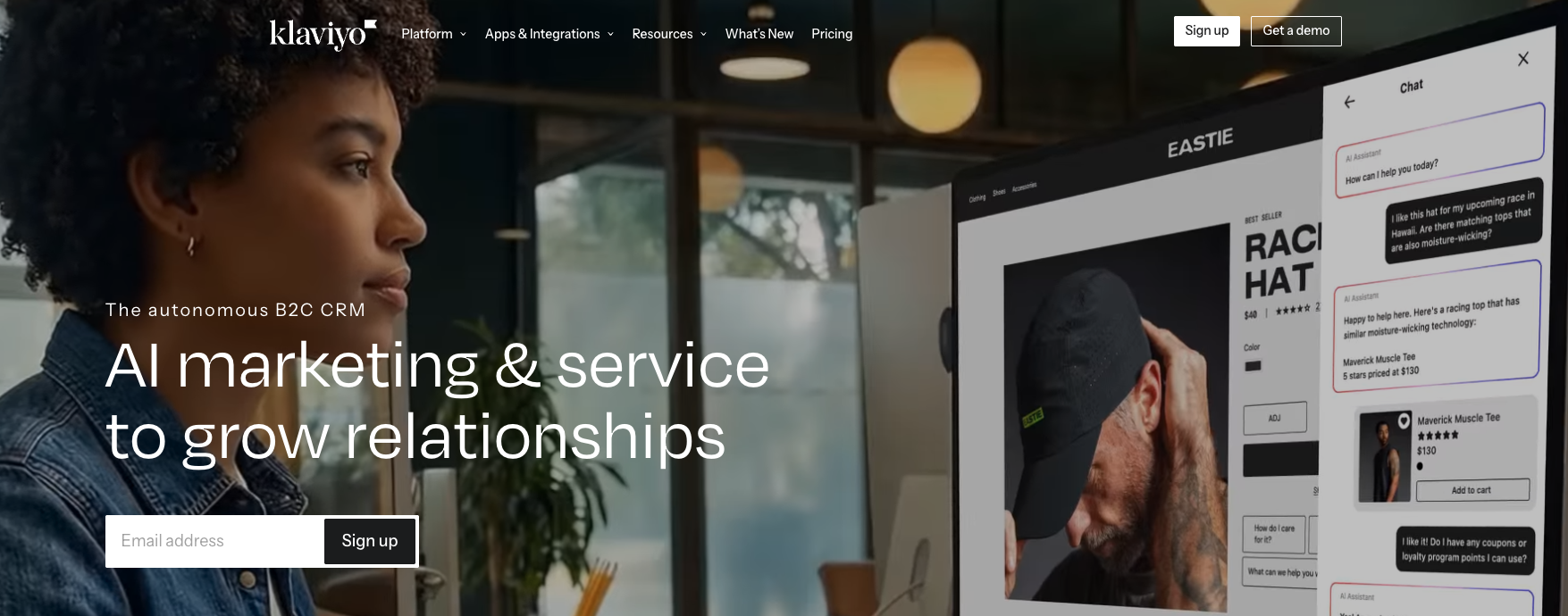 Its segmentation is genuinely strong. You can slice your audience by what people bought, what they browsed, how much they've spent, and when they last engaged. Then you can tie campaigns back to revenue, so you see which flows actually drive sales instead of just opens.
The SMS tools are baked in too, which makes it easier to run email and text from one place. For brands that live and breathe their customer data, Klaviyo can feel like home.
But that power has a cost. The interface overwhelms a lot of users, especially smaller teams without a dedicated email specialist. And the pricing climbs fast as your active profiles grow, with no annual discount to soften the blow as of 2026, which is why plenty of stores end up weighing Klaviyo alternatives.
Who Should Choose Klaviyo
Klaviyo suits established ecommerce brands with the team and budget to use it well. If you want deep behavioral automation and you've got someone who can own the platform, it's a serious contender.
Mailchimp: The Familiar Generalist
Mailchimp is the name almost everyone knows. It started as a newsletter tool and grew into a broad marketing suite covering email, landing pages, ads, and basic automation. For sheer approachability, it's hard to beat.
 The editor is friendly, the templates are clean, and you can get a campaign out the door in minutes. For a small business sending newsletters and the occasional promo, that simplicity is a real strength.
The trouble starts when you ask it to behave like an ecommerce engine. Its automation is thinner than Klaviyo's, and the deeper ecommerce features only unlock on the Standard plan and up. Cart and browse abandonment flows exist, but they don't go as deep.
Then there's the billing. Mailchimp charges on your total contact count, including people who already unsubscribed. So you can pay to store contacts you legally can't even email. Add the gutted free plan from January 2026 and the paid transactional email add-on, and the "cheap" option gets pricey in a hurry, which pushes some brands to compare Mailchimp alternatives.
Who Should Choose Mailchimp
Mailchimp works best for beginners, service businesses, and brands whose email needs are mostly newsletters and announcements. If ecommerce revenue isn't the main job of your email program, it'll do fine.
Where Both Tools Fall Short for Ecommerce
Here's the thing the Klaviyo vs Mailchimp framing misses. You're not really choosing between two tools. You're choosing how you want to compromise.
With Klaviyo, you get ecommerce depth, but you pay for it in dollars and in complexity. The bill grows with every active profile, and the learning curve can stall a small team for weeks.
With Mailchimp, you get simplicity and a low entry price, but you give up the automation and revenue focus that actually move the needle for a store. And its contact-based billing punishes you for list growth you haven't even monetized yet.
So what if you didn't have to pick a side? That's exactly the gap a third option fills.
A Better Fit for Ecommerce: Drip
Drip is an ecommerce marketing automation platform, not a generic email tool stretched to fit. It's built to ingest your purchase data, catalog, and browsing behavior, then turn all of it into automated, personalized revenue. Think Klaviyo-level ecommerce power, with an interface a non-developer can actually master.
 Start with the workflow builder. You map customer journeys visually, with branching logic, goals, and split testing, so an abandoned-cart shopper who buys after the first nudge never gets the follow-up. It's the kind of automation Klaviyo offers, without the overwhelm Mailchimp can't match.
Drip also focuses on the metric that pays your bills: Revenue Per Person, not just open rates. It connects to Shopify, WooCommerce, and BigCommerce with real-time sync, so your segments update the moment a shopper hits a spending threshold or browses a new category.
And because Drip acquired Sleeknote, onsite popups, slide-ins, quizzes, and Spin to Win come built in at every plan. You capture the email and trigger the welcome flow from the same platform, no extra tool required.
The results show up in the numbers. Spring Copenhagen grew average order value by 32.24% and nearly doubled newsletter click-through (up 96%). Nifty Gifts saw a 77% revenue increase in its first two months, with a 46% open rate on its abandoned-cart workflow. And of ten featured Drip customers, four switched from Klaviyo, citing ease of use as the main reason.
Where Drip Falls Short
Drip isn't a freemium tool, so the $39 per month entry price sits above Mailchimp's cheapest paid tier. It's a premium platform for brands that are serious about revenue, not a free starter app.
Who Should Choose Drip
Drip is the sweet spot for growing ecommerce brands that want real automation without Klaviyo's complexity or Mailchimp's ceiling. If you sell on Shopify, WooCommerce, or BigCommerce and you want every feature at every plan with transparent pricing, Drip is built for you.
Pricing Compared: Klaviyo vs Mailchimp vs Drip
Pricing is where the Klaviyo vs Mailchimp decision gets tricky, because the two count contacts in completely different ways. Here's how all three approach it.
Klaviyo bills on active profiles, meaning people you can actually email. Its Email plan starts around $20 per month for 251 to 500 active profiles, and it scales up quickly from there with no annual discount in 2026.
Mailchimp bills on total contacts, including unsubscribed ones still sitting in your account. Essentials starts around $13 per month and Standard around $20 per month, but the Premium tier jumps to roughly $350 per month, and transactional email is a paid add-on.
Drip starts at $39 per month for up to 2,500 active people, and every plan includes the same full feature set, no gates. Inactive contacts aren't billed, and qualifying brands get free migration handled by Drip's team. For a store comparing real ecommerce capability dollar for dollar, that flat, all-in approach is often the cleaner deal.
The Bottom Line
Both platforms can send your emails. Klaviyo will give you ecommerce depth at a rising price, and Mailchimp will give you simplicity that runs out of room as you grow.
But if you want a revenue engine that turns shopper data into automated, personalized sales, without the complexity or the surprise bills, Drip is the smarter middle ground for ecommerce brands.
Ready to see the difference? Try Drip free for 14 days. No credit card required.