The best email marketing software for ecommerce is Drip. It's purpose-built for online stores, ties every email to revenue, and runs behavioral automations off real store data instead of generic newsletter blasts. Most other tools send email well. Drip is built to sell more product.
If you run a Shopify, WooCommerce, or BigCommerce store and you want a platform that turns customer behavior into automated sales, Drip is the clear pick. Below, you'll see how it stacks up against seven popular alternatives, with current pricing and honest trade-offs for each.
What You'll Find in This Post
- The Best Ecommerce Email Tools at a Glance
- Quick Comparison Table
- 1. Drip: Best Overall for Ecommerce Revenue
- 2. Klaviyo: Best for Data-Heavy Enterprise Brands
- 3. Omnisend: Best Budget Omnichannel Option
- 4. Mailchimp: Best for General Small Business
- 5. Shopify Email: Best for Bare-Bones Shopify Sends
- 6. Brevo: Best for Cheap Email Volume
- 7. ActiveCampaign: Best for Complex B2B Automation
- 8. MailerLite: Best for Tiny Budgets
- How I Evaluated These Ecommerce Email Tools
- The Bottom Line
The Best Ecommerce Email Tools at a Glance
Here's the ranking of the best email marketing software for ecommerce in 2026:
- Drip — Best for revenue-focused ecommerce automation
- Klaviyo — Best for data-heavy enterprise brands
- Omnisend — Best budget omnichannel option
- Mailchimp — Best for general small business
- Shopify Email — Best for bare-bones Shopify sends
- Brevo — Best for cheap email volume
- ActiveCampaign — Best for complex B2B automation
- MailerLite — Best for tiny budgets
Let me walk you through each one so you can match the right tool to your store.
Quick Comparison Table
Here's how the eight platforms compare on starting price, free plan, and ecommerce focus (pricing accurate as of June 2026):
| Tool | Starting price | Free plan? | Built for ecommerce? | Best for |
|---|---|---|---|---|
| Drip | $39/mo (up to 2,500 people) | 14-day trial, no card | Yes, purpose-built | Revenue-focused ecommerce automation |
| Klaviyo | $20/mo (251–500 profiles) | Yes, up to 250 profiles | Yes | Data-heavy enterprise brands |
| Omnisend | ~$16/mo (500 contacts) | Yes, limited | Yes | Budget omnichannel |
| Mailchimp | $13/mo Essentials, $20/mo Standard | Yes, limited | No, generalist | General small business |
| Shopify Email | $1 per 1,000 emails after 10k free | 10,000 free emails/mo | Partly, Shopify only | Bare-bones Shopify sends |
| Brevo | $9/mo (5,000 emails) | Yes, 300 emails/day | No, generalist | Cheap email volume |
| ActiveCampaign | $15/mo (1,000 contacts) | No, 14-day trial | Partly | Complex B2B automation |
| MailerLite | $10/mo Growing Business | Yes, up to 500 subscribers | No, generalist | Tiny budgets |
1. Drip: Best Overall for Ecommerce Revenue
Drip is an ecommerce marketing automation platform, not a generic email service provider. It ingests purchase data, catalog information, and browsing behavior, then turns all of it into automated, personalized messages that drive sales.

So what makes Drip different? It measures Revenue Per Person, not just open rates. You can see exactly which emails and workflows are generating sales, which means you stop guessing about what's working.
The automation engine is where Drip pulls ahead. Its visual workflow builder handles branching logic, Goals, and split tests, with 15-plus pre-built templates for welcome series, abandoned cart, browse abandonment, win-back, and back-in-stock. If a shopper buys mid-sequence, a Goal node skips them past the rest. No awkward "you left something behind" email after they already checked out.
And the store integrations run deep. Drip syncs full customer, order, and product data from Shopify, WooCommerce, and BigCommerce in real time, so your segments update the moment someone's behavior changes. It also includes an onsite suite (popups, slide-ins, sticky bars, Spin-to-Win, and quizzes via the Sleeknote technology Drip acquired) on every plan at no extra cost.
The results back it up. Drip has driven over $1.5 billion in attributed revenue across its 6,000-plus brands. Nifty Gifts saw a 77% revenue increase in two months. Spring Copenhagen lifted average order value 32.24% and nearly doubled email click-through rates.
Where Drip Falls Short
Drip starts at $39 per month, higher than the freemium tools on this list. It's a premium platform built for stores that take revenue seriously, not a free side-project tool.
Who Should Choose Drip
Drip is for ecommerce brands that want automation tied directly to revenue. If you're on Shopify, WooCommerce, or BigCommerce and you're tired of blasting your whole list and hoping for sales, Drip gives you the behavioral targeting and attribution to grow on purpose. It's especially strong for fashion, home goods, health and beauty, and food and beverage brands that live on repeat purchases.
2. Klaviyo: Best for Data-Heavy Enterprise Brands
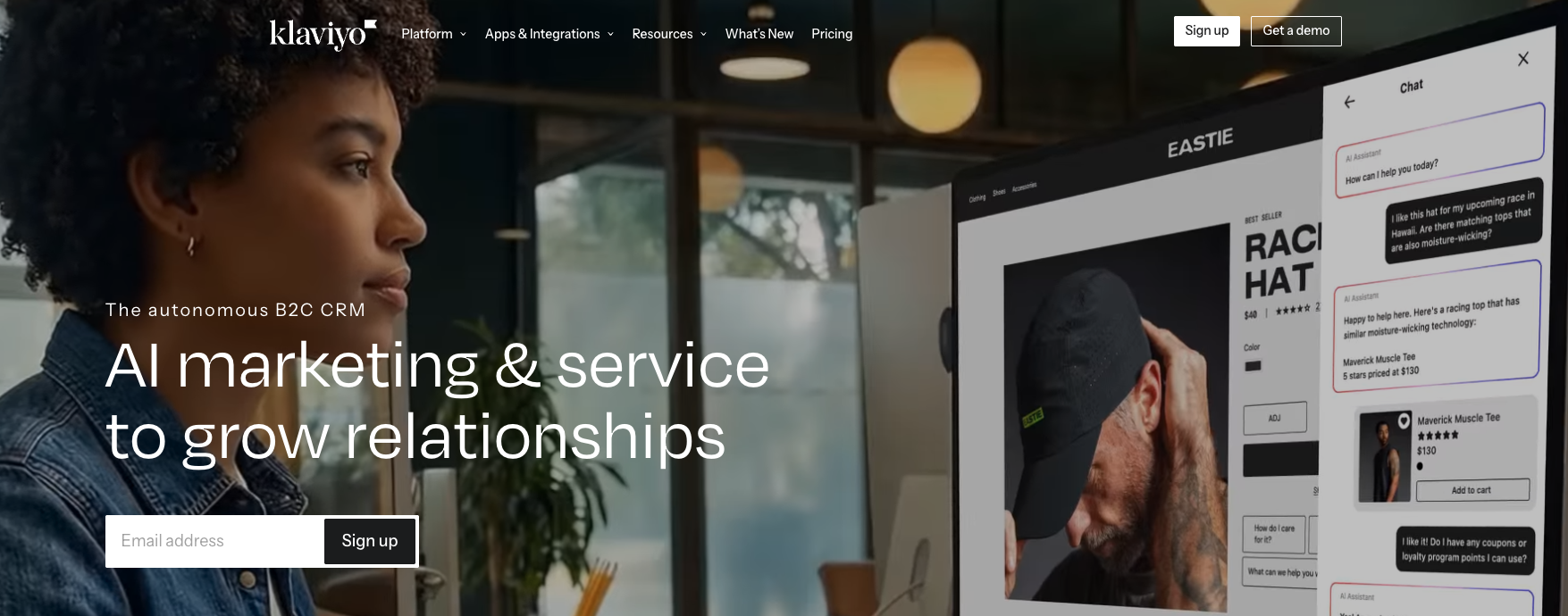
Klaviyo is Drip's closest competitor in ecommerce automation. It's a powerful, data-rich platform with strong segmentation, predictive analytics, and a large app ecosystem, and bigger brands with dedicated email teams tend to like it.
Where does it get tricky? Pricing.
As of February 2025, Klaviyo bills on your total active profiles, meaning every contactable profile counts whether you email them or not. It starts at $20 per month for 251 to 500 profiles, but costs climb fast as your list grows, often reaching several hundred dollars a month for mid-size brands and into four figures for large lists. Many teams also find it steeper to learn than Drip, especially without a developer on hand.
Who Should Choose Klaviyo
Klaviyo fits established, data-heavy brands with the budget and the in-house expertise to run a complex platform. If you've outgrown simpler tools and you want deep analytics with the staff to manage them, it's a serious option. Worth noting: four of ten featured Drip customers switched from Klaviyo, citing ease of use as the main reason.
3. Omnisend: Best Budget Omnichannel Option
Omnisend is built for ecommerce and combines email, SMS, and push in one tool. It's affordable, with a Standard plan starting around $16 per month for 500 contacts, and it's an easy on-ramp for smaller stores that want omnichannel without enterprise pricing.
 But there's a catch as of 2026. SMS is no longer available on Free and Standard plans for customers who subscribed on or after May 4, 2026, so you'll need to upgrade to Pro to send texts. And while Omnisend covers the basics well, its automation logic and segmentation aren't as deep or as revenue-focused as Drip's, so growing brands can hit a ceiling.
Who Should Choose Omnisend
Omnisend works for small to mid-size stores that want email and SMS in one affordable tool and don't need advanced branching automation yet. It's a solid starter. Just know you may outgrow it as your automation needs mature.
4. Mailchimp: Best for General Small Business
Mailchimp is the most recognized name in email marketing, and for good reason. It's approachable, has a friendly editor, and works across many industries, not just ecommerce. Paid plans start at $13 per month for Essentials and $20 per month for Standard at 500 contacts.

The problem for online stores is that Mailchimp is a generalist. It was built for newsletters, so it lacks the granular revenue attribution and behavioral triggering that ecommerce brands rely on. Essentials doesn't even include multi-step automation. And like Klaviyo, Mailchimp bills on your total contact count, including unsubscribed contacts still sitting in your account, so costs can creep up unexpectedly.
Who Should Choose Mailchimp
Mailchimp suits small businesses and non-ecommerce senders who want a familiar, easy tool for simple campaigns. If your store needs serious automation tied to purchase behavior, though, you'll likely outgrow it quickly.
5. Shopify Email: Best for Bare-Bones Shopify Sends
Shopify Email is the native email tool inside Shopify, and its pricing is hard to beat for light senders. You get 10,000 free emails per month, then pay just $1 per 1,000 emails after that. It lives right in your Shopify admin, so there's nothing to integrate.
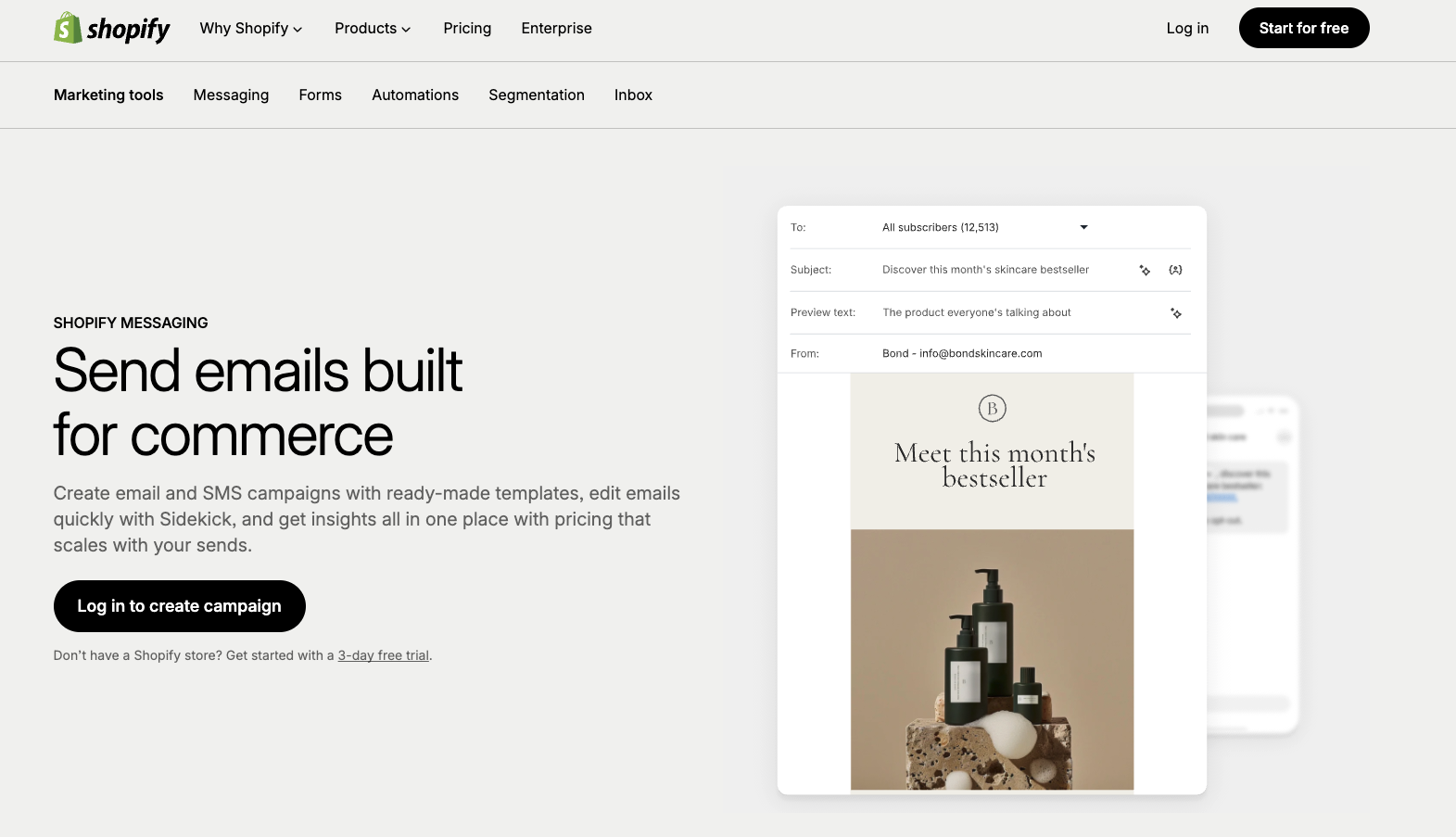 So why isn't it higher? Because it's intentionally basic. Shopify Email handles simple campaigns and a handful of automations, but it lacks the sophisticated workflows, dynamic segmentation, and revenue attribution that a dedicated platform like Drip provides. It's a starting point, not a growth engine. And it only works if you're on Shopify.
Who Should Choose Shopify Email
Shopify Email is fine for brand-new Shopify stores sending occasional campaigns on a shoestring. As soon as you want real automation that drives repeat purchases, you'll want to graduate to a purpose-built tool.
6. Brevo: Best for Cheap Email Volume
Brevo, formerly Sendinblue, is one of the most affordable ways to send high volumes of email. Its free plan allows 300 emails per day with storage for up to 100,000 contacts, and paid plans start at $9 per month for 5,000 emails. Because it bills on sends rather than contacts, it can be cheap for large lists.
 The trade-off is depth. Brevo is a generalist built for email and transactional messaging, not ecommerce growth. Its product blocks, behavioral automation, and store integrations are shallower than Drip's, and the free plan's 300-emails-per-day cap can choke a real campaign schedule.
Who Should Choose Brevo
Brevo is a good fit for budget-conscious senders who prioritize volume and transactional email over advanced ecommerce automation. If cost-per-send is your main metric, it's worth a look.
7. ActiveCampaign: Best for Complex B2B Automation
ActiveCampaign is a powerful automation platform with a deep feature set. Its Starter plan runs $15 per month for 1,000 contacts (billed annually), scaling up through Plus, Professional, and Enterprise tiers. The automation builder is genuinely strong.
 But ActiveCampaign serves a broad audience and leans heavily toward B2B and service businesses. For product-based retailers, its ecommerce integration depth (dynamic product blocks, real-time catalog sync, store-specific attribution) isn't as purpose-built as Drip's. There's also no free plan, only a 14-day trial, and lower tiers cap automation actions.
Who Should Choose ActiveCampaign
ActiveCampaign is excellent for B2B companies, agencies, and service businesses that need sophisticated, multi-channel automation. For a store whose growth depends on catalog data and purchase behavior, a dedicated ecommerce platform will serve you better.
8. MailerLite: Best for Tiny Budgets
MailerLite earns its name. It's clean, simple, and one of the most generous free plans around, letting you send up to 12,000 emails to 500 subscribers per month for free. Paid plans start at $10 per month, and the editor is a pleasure to use.
 That simplicity is also the limit. MailerLite is a generalist email tool, so its ecommerce automation, segmentation, and revenue tracking are basic compared to a store-focused platform. It's great for getting started and light on growth firepower.
Who Should Choose MailerLite
MailerLite is ideal for solopreneurs, content creators, and very small stores on the tightest budgets who want clean, simple email. When you're ready to automate around shopper behavior and chase repeat revenue, you'll want to step up to a dedicated ecommerce tool.
How I Evaluated These Ecommerce Email Tools
I ranked each platform on how deeply it integrates with your store's data, the sophistication of its automation engine, and whether it actually tracks revenue rather than just opens and clicks. Pricing transparency and ease of use for non-technical marketers weighed heavily too, because the best platform in the world is useless if your team can't run it. Tools built specifically for ecommerce rose to the top. Generalist newsletter tools, however capable, ranked lower for online stores.
The Bottom Line
Every platform on this list can send email. But if you want the best email marketing software for ecommerce, you want a revenue engine that turns customer data into automated, personalized sales. That's Drip.
For online stores that are serious about growth, Drip's purpose-built automation, deep store integrations, and revenue attribution make it the clear choice.
Ready to see the difference? Try Drip free for 14 days. No credit card required.